

Introduction
As an Odoo Partner, choosing the right hosting environment is instrumental in delivering successful ERP implementations. Your hosting choice directly impacts overall performance, reliability, and long-term scalability. These factors influence your customer’s experience and perception of your services.
Many Odoo Partners struggle to choose the best hosting option, especially without a clear framework for evaluation. This can result in higher operational overhead, lower customer satisfaction, and reduced project success. A structured approach is essential to help partners assess, compare, and select the most suitable hosting solution for their business.
In this guide, you’ll see the best Odoo hosting options you can use as an Odoo Partner. Additionally, you’ll see the factors to consider when choosing one.
Understanding Odoo Partner Needs
Odoo partners operate multi-client environments which require flexibility, reliable performance, and long-term support. The best Odoo hosting option must meet technical requirements and provide operational support for large-scale ERP implementations over time. Here are key areas you should evaluate as an Odoo partner before choosing an Odoo hosting environment:
Performance requirements for multi-client environments: Managing multiple clients simultaneously requires hosting that can handle rapid load times and deliver optimized database performance even during peak usage.
Scalability considerations: With increasing users, transactions and new modules, you need hosting that scales seamlessly. A scalable host ensures partners don’t have to migrate due to disruptions.
Support and maintenance expectations: For seamless operations, you need a predictable support structure. Partners require hosting options that provide automated backups, regular updates, technical assistance and maintenance at a minimal rate. This focuses your attention on implementation, customization and advisory services.
Security and compliance requirements: Reliable security controls are critical due to the sensitivity of business data across sectors such as finance, HR, sales, and operations. To prevent security breaches, look for hosting options that comply with industry regulations (e.g., GDPR, ISO and SOC).
Best Odoo Hosting Options for Odoo Partners
We’ll review three leading Odoo hosting options for Odoo partners:
- Cloudpepper
- AWS (Amazon Web Services)
- DigitalOcean
1. Cloudpepper
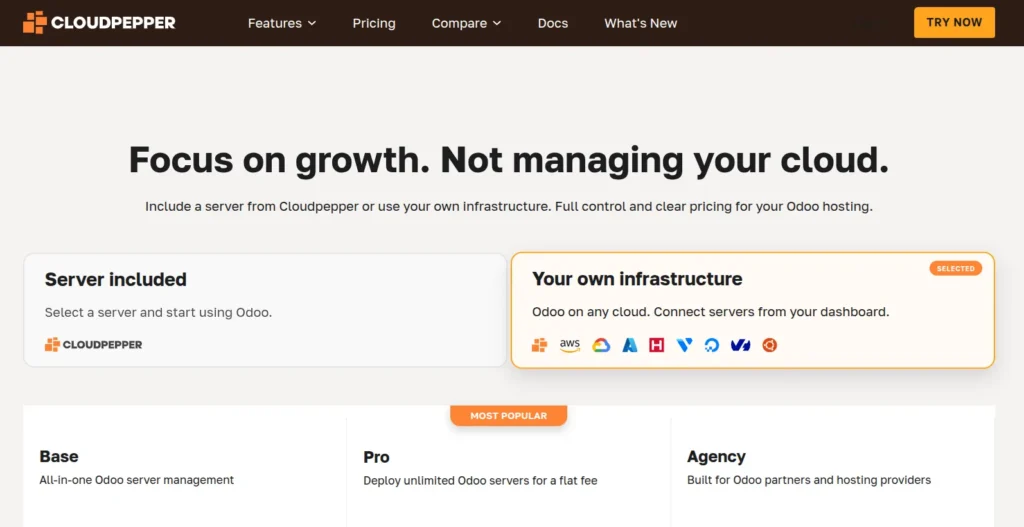
Cloudpepper is a hosting platform created to support Odoo implementations at scale, trusted by 10,000+ Odoo projects in 130+ countries. This platform was designed as a better alternative to official Odoo platforms (Odoo Online and Odoo.sh). It combines high-performance infrastructure with automation and management tools to make deployment, monitoring and maintenance straightforward for partners managing multiple clients.
Two Deployment Models
Cloudpepper offers flexibility in how you approach infrastructure:
Managed Hosting: A complete turnkey solution where Cloudpepper provides the servers, handles all technical configuration, and manages everything. You simply use your Odoo system without touching any infrastructure.
DevOps Platform: You connect your existing AWS, DigitalOcean, Vultr, or even on-premise infrastructure to Cloudpepper’s management platform. They handle all Odoo-specific configuration and maintenance while you retain complete ownership of the underlying infrastructure.
Both models provide identical features: unlimited staging environments, Git integration with any repository, automated backups, and access to 900+ pre-vetted third-party Odoo addons. The DevOps model gives you infrastructure ownership and eliminates vendor lock-in entirely.
If you ever cancel Cloudpepper’s DevOps service, your servers and data remain intact with your cloud provider. No migration, no data exports, no transition headaches.
Key Features
Odoo-Optimized Infrastructure:
The Cloudpepper hosting environment is built to meet Odoo’s technical requirements, including fast database performance, optimized server configuration, and adaptive caching frameworks. This delivers consistent performance for multiple clients’ workloads and for demanding Odoo modules such as Inventory, Manufacturing, and POS.
Partner-Aligned Functionalities and Support:
Cloudpepper offers tools to streamline partner operations, including client instance grouping, custom domain management, resource tracking, and dedicated account support. The support team is specifically trained in partner deployment needs, providing reliable technical assistance.
Automated Deployment and CI/CD Pipeline:
One-click deployment, automated backups, continuous monitoring and Git-based CI/CD pipelines allow you to manage multiple instances simultaneously with minimal manual effort. When a developer pushes code to a client’s branch, the system fetches the custom code, installs Python dependencies, and updates Odoo modules automatically with zero downtime.
This automation reduces setup time, minimizes human error, and enables partners to deliver projects more quickly and efficiently.
Unlimited Staging and Production Environments:
Test changes, try new modules, and validate configurations in isolated environments before pushing anything to production. Each client can have multiple staging environments for thorough testing with real data before going live. This dramatically reduces the risk of changes affecting live business operations.
Multi-Client Management Dashboard:
Cloudpepper provides a powerful dashboard that centralizes your view across all client accounts. See resources, health, and Odoo versions for every client instance from a single screen. When a client reports slow performance, you can check CPU usage, review server logs, and restart the Odoo service all from one tab.
The platform supports user management with granular permissions. Control who on your team can access which client instances and what actions they can perform.
Pricing Structure
Cloudpepper offers a free Core plan for testing with one instance on any cloud provider.
Managed Hosting (server included):
- Base: $41/month
- Pro: $61/month (unlimited servers)
- Agency: $262/month (white-label capabilities)
DevOps Platform (your infrastructure):
- Base: $29/month
- Pro: $49/month (unlimited servers)
- Agency: $250/month (white-label capabilities)
Cloudpepper’s Agency and Pro plans include unlimited servers, instances, and staging environments for one flat monthly fee. No per-user charges, no surprise fees for additional environments.
Pros
- Automation-first design: Enables rapid deployment, reduces manual server management workload for partners
- Partner-aligned functionalities and support: Provides specialized support for handling multiple client installations and workloads
- Optimized for Odoo: Offers reliable and high-performance operations compared to general-purpose cloud servers
- Zero vendor lock-in: DevOps model lets you own your infrastructure completely
- Unlimited scaling: Flat rate for unlimited instances and environments
- White-labeling: Agency plan allows complete brand customization
- API Access
Cons
- Higher cost than basic VPS: More expensive than unmanaged VPS hosting or shared cloud environments
- Requires basic cloud knowledge: Setting up initial cloud servers needs some technical familiarity
2. AWS (Amazon Web Services)
Amazon Web Services is a platform for cloud computing that allows flexible applications to be developed. It provides elastic infrastructure scalability, messaging, analytics, data storage and security services. It is recognized as the first provider of cloud computing services.
Key Features
Enterprise-Grade Infrastructure:
AWS offers high-performance virtual machines (EC2), load balancers, managed databases and storage solutions optimized for demanding workloads. With AWS, you can build resilient environments able to support extensive user bases and resource-intensive Odoo modules.
Global Data Center Availability:
AWS has data centers across various regions worldwide, allowing you to deploy close to specific clients’ locations. This proximity lessens latency, ensures improved performance and enables partners to meet various data compliance needs of each region, especially when international clients are involved.
Flexible Scaling Options:
Supports both horizontal and vertical scaling, ensuring Odoo instances grow alongside client demands. You have freedom to design and optimize desired performance for your workload whether by adding more CPU/RAM to a server or creating multiple node architectures that balance load.
Pricing
AWS uses a pay-as-you-go pricing model that bills according to compute, network, and storage usage. Basic production setups start around $50-100/month, but enterprise deployments with high availability and auto-scaling typically run $500-1,000+/month. The final cost depends on your usage and configuration.
Pros
- Flexible and customizable: Ideal for complex Odoo deployments
- Powerful scaling options: Suitable for large and rapidly-growing businesses
- Global infrastructure: Deploy anywhere with regional compliance support
Cons
- Complex setup and management: Requires significant technical expertise
- Costs can escalate: As business grows and more complex architectures are deployed with high-usage workloads, costs increase substantially
- No Odoo-specific optimization: General-purpose cloud requires manual optimization
Recommended For
Odoo partners who prefer full server control, customized architectures, enterprise-scale deployment and strict compliance regulations.
3. DigitalOcean
DigitalOcean offers an Infrastructure as a Service (IaaS) environment primarily for hosting applications and websites. It is famous for its simplicity, developer-friendliness and affordability, providing a way to deploy Odoo on flexible virtual machines without the complexity of larger cloud providers.
DigitalOcean provides a solid balance between cost, performance and simplicity of usage for partners operating with multiple small to medium sized projects.
Key Features
Balance of Efficiency and Cost:
DigitalOcean provides efficiency and smooth performance for everyday Odoo workloads such as handling typical modules: accounting, inventory and CRM. It offers the opportunity to host projects at a budget-friendly rate while still offering reliable experiences.
Strong Developer Tools:
The developer ecosystem includes features like 1-click apps, monitoring dashboards, managed databases, private networking and API-driven automation. These tools simplify partner management and provide flexibility to adjust to evolving projects.
Comprehensive Documentation:
DigitalOcean guides new users to the cloud with elaborate guides leading through complex setups. The robust community system provides additional support and resources.
Pricing
Starting at $4-5/month for basic droplets with a predictable monthly pricing model and low entry fees. Production-grade configurations typically run $20-50/month.
Pros
- Ease of use: Design is easy to understand and navigate with rapid deployment
- 99.99% uptime guarantee: Reliable availability for production systems
- Affordable pricing: Ideal for small clients working on budget-sensitive projects
- Developer-friendly: Simple interface and strong documentation
Cons
- Limited global locations: Fewer deployment regions compared to AWS
- Less enterprise features: Not ideal for complex, large-scale deployments
- Manual Odoo optimization required: No built-in Odoo-specific features
Recommended For
Odoo Partners who want cost-effective hosting, small to medium scale deployments and developers who need a simplified system.
Key Hosting Considerations for Odoo Partners
The right hosting strategy for Odoo deployment goes beyond selecting a provider. It involves planning, data protection, performance, and maintenance. Partners evaluate the best Odoo host options based on the client’s current and future needs to ensure scalability, security and smooth deployments.
Multi-Tenancy vs. Dedicated Instances
Multi-tenancy: Multiple client databases share the same server resources. This approach is easy to manage, cost-effective, and suitable for small to medium-sized clients with predictable workloads. However, it may result in performance fluctuation across multiple clients.
Dedicated instances: Each client receives a separate server. This provides maximum performance and flexibility for customization. Ideal for large client bases, compliance-sensitive industries, and resource-intensive modules.
Backup and Disaster Recovery
Implement automated daily backups, periodic testing of restorative measures to ensure reliability, and versioned backups for fast recovery in case of errors or accidental deletion.
Database Management and PostgreSQL Optimization
PostgreSQL is the backbone of Odoo. Its performance depends on proper database management, such as regular indexing to improve query performance and monitoring database growth to optimize storage for large transaction workloads.
Update and Maintenance Workflows
Keep Odoo projects current without client disruption by scheduling updates during low-usage hours and using staging environments to test new versions before deployment. This reduces risk and time spent on updates and deployments.
Performance Optimization Strategies
To deliver smooth and responsive ERP experiences, high Odoo performance is essential. Key strategies include:
Caching layers: Implement Redis or Memcached for frequently used data to minimize database load and reduce latency.
CDN Integration: Use a content delivery network to serve static assets from servers close to end users, enhancing performance for geographically distributed clients.
Load Balancing: Distribute traffic across multiple Odoo projects or application servers to automatically route traffic to healthy servers and scale horizontally as demand grows.
Database Indexing: Optimize PostgreSQL performance by creating indexes on frequently queried columns and monitoring slow queries to decrease execution time.
Cost Management for Partner Businesses
Managing hosting cost-effectively is important for Odoo partners. Key strategies include:
Pricing Models Comparison:
- Pay-As-You-Go: Flexible, ideal for projects with varying workloads or short-term client projects
- Reserved Instances: Prepaid model with discounted rates for long-term commitments, suitable for stable projects with predictable workloads
Resource Allocation: Monitor CPU, RAM, storage and bandwidth usage for each client. Use multi-tenancy for smaller clients to reduce costs. Allocate dedicated resources to high-demand clients or compliance-sensitive environments.
Monitoring Tools: Implement cloud providers’ cost dashboards, alerts and third-party monitoring tools to track usage trends and identify underutilized instances.
When to Consolidate: Combine multiple client databases into a single instance for clients with predictable, moderate workloads. Larger clients and compliance-sensitive environments should have separate instances.
Security and Compliance Framework
Odoo partners need to protect client data, build trust and meet compliance requirements.
SSL/TLS Implementation: Use SSL/TLS certificates to encrypt all data in transit. Ensure certificates are valid, up to date and correctly configured.
Regular Security Patching: Update all operating systems, PostgreSQL, Odoo modules and dependencies with security patches. Implement automated patching, but verify updates in staging environments before deployment.
GDPR and Data Residency: Ensure hosting providers and deployment locations comply with GDPR and other relevant data protection requirements. Research and adhere to regional data residency laws.
Client Data Isolation: Use dedicated databases for clients managing sensitive information. Adhere strictly to access control and role-based permissions. Incorporate regular audits and monitoring to detect and avoid misconfigurations and potential breaches.
Conclusion
For Odoo partners, choosing the right hosting platform depends on your clients’ needs, technical capabilities, and growth plans. Cloudpepper delivers specialized Odoo hosting with partner-focused features, automation, and zero vendor lock-in through its DevOps platform. AWS provides enterprise-grade infrastructure with maximum control for complex deployments. DigitalOcean offers simplicity and affordability for small to medium projects.
Start with Cloudpepper’s free Core plan to evaluate their platform. Most partners find that specialized Odoo hosting with dedicated resources, unlimited environments, and partner-aligned features delivers the best long-term value for multi-client management.
