How Much Does Odoo Cost? Odoo Pricing Explained
Understand Odoo pricing across licenses, hosting, implementation, migration, custom development, support, and upgrades.
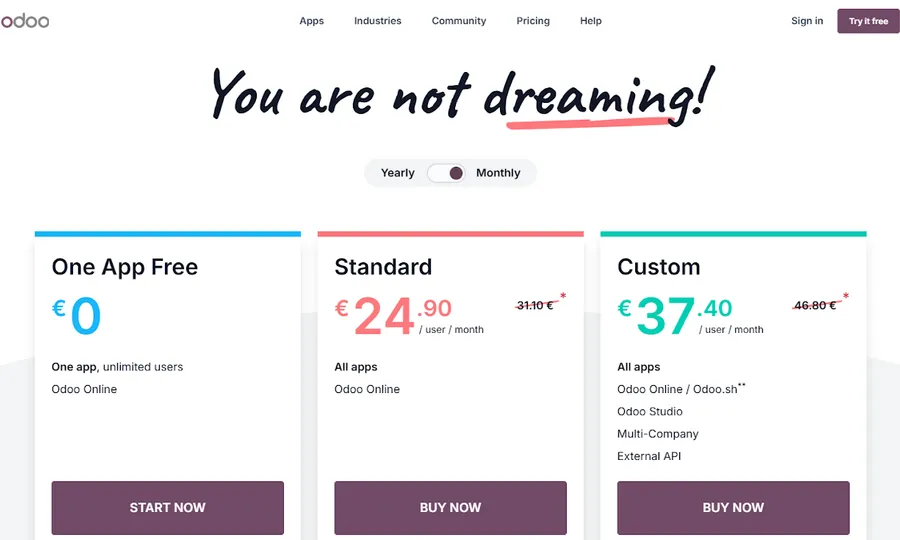
The answer to “How much does Odoo cost?” depends on more than the license price. Odoo can be inexpensive to start, but your final cost depends on users, edition, hosting, implementation, migration, custom development, support, and upgrades.
To price Odoo accurately, separate software licensing from the technical work around it. That matters for agencies too, because hosting and maintenance choices can make or break margins across multiple client implementations.
This guide breaks down the main cost categories and shows how infrastructure choices affect long-term spend.
How Much Does Odoo Cost? – Key Takeaways
-
Odoo pricing depends on your edition, user count, hosting setup, and implementation approach. Odoo Community is free to license but carries infrastructure and maintenance costs. Odoo Enterprise pricing varies by country, billing term, and promotion, so check Odoo’s pricing page for live rates.
-
Beyond licensing, your true cost of ownership includes Odoo hosting, implementation, data migration, custom development, training, and annual version upgrades. For businesses on a Custom plan, Odoo hosting is often the most controllable recurring cost and the most impactful on long-term margins.
-
Hosting options range from Odoo Online (free, but no customization) to unmanaged VPS (cheap, but fully self-managed) to specialized platforms like Cloudpepper, which offers flat-rate managed Odoo hosting starting at $29/month. This eliminates the per-worker and per-storage charges common on Odoo.sh, making it a practical option for growing businesses and Odoo agencies managing multiple clients.
-
Real-world Year 1 costs typically fall between $7,000 for a small 5-user startup and $138,000+ for a 100-user multi-location retail chain, depending on implementation complexity and infrastructure choices.
Understanding Odoo Pricing Structure
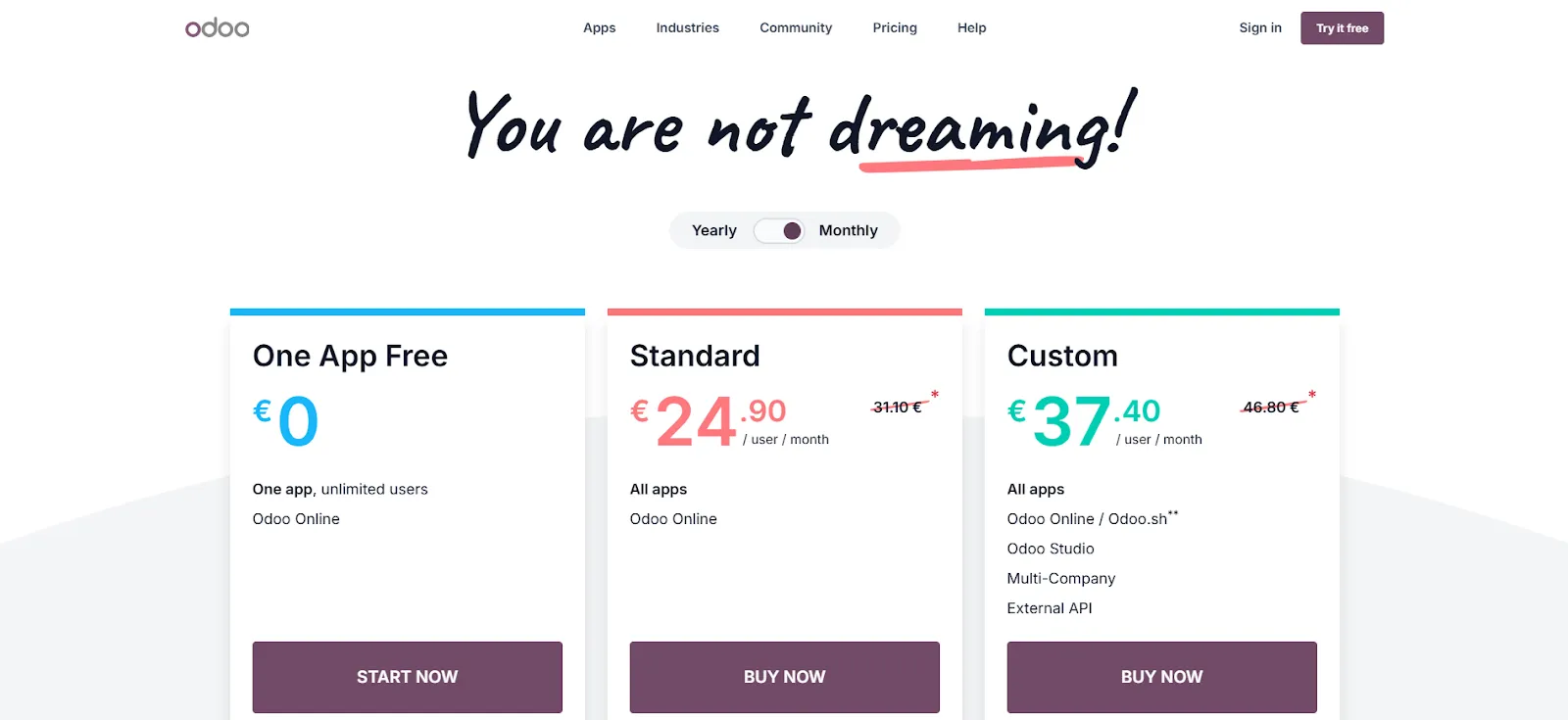
Odoo pricing is mainly determined by the specific edition you’re using. So, to understand Odoo pricing, you must first understand the Odoo editions. There are currently two main Odoo editions: Odoo Community and Odoo Enterprise.
While a specific edition lays the foundation for your costs, other factors, such as your chosen hosting infrastructure, also directly affect your pricing structure.
Odoo Community (The Free Version)
Odoo Community is the free and open-source version of Odoo that provides a solid foundation for basic business needs such as CRM, sales, and inventory.
While this edition is labeled “free,” that only refers to the license. You still need to budget for hosting, version updates, security patches, backups, and support.
The Odoo Community Edition is excellent for businesses that do not require advanced automated workflows and that have a dedicated technical team that manages their own infrastructure. If you want Community without staffing that team, managed Odoo Community hosting runs the stack for you and folds those infrastructure costs into a predictable monthly price. A major limitation of this edition is its lack of a mobile app and of advanced modules available in the Enterprise edition, such as Multi-company Consolidation and Full Accounting.
Odoo Community can be very cost-effective when you already have the technical capacity to run it well.
Odoo Enterprise (The Paid Version)
The Odoo Enterprise version, commonly called the paid version, offers more advanced features than Odoo Community. With Odoo Enterprise, you can access every app on Odoo. This edition has two main pricing tiers: the standard and custom plans.
On a standard Odoo Enterprise plan, you can access all standard Odoo apps and unlimited support. However, you cannot integrate third-party applications or custom modules. In addition, you must host the ERP on Odoo Online on a standard plan. Odoo publishes current Standard pricing on its pricing page, with rates varying by country, billing term, and promotion.
The Custom plan is more flexible. It includes features such as Odoo Studio and external API access, which matters when you need third-party integrations, custom modules, or partner-managed deployments.
You also have more flexibility with hosting as it supports Odoo Online, Odoo.sh, and cloud or on-premise hosting. Odoo publishes current Custom pricing on its pricing page, with similar billing-term considerations as the Standard plan.
Note that, regardless of the plan, pricing on Odoo Enterprise remains strictly per user, per month.
The One App Free Plan
Odoo’s One App Free plan gives you one app for unlimited users at no license cost. Dependent apps needed to run that main app are included too.
However, this plan is hosted on Odoo Online, which restricts user customization. In addition, if a user installs another unrelated app, the system automatically enrolls the business in a paid plan, either the standard or the custom plan.
It can be a useful way to start small, especially for agencies introducing a client to Odoo before a broader rollout.
What Makes Up Your Total Odoo Cost?
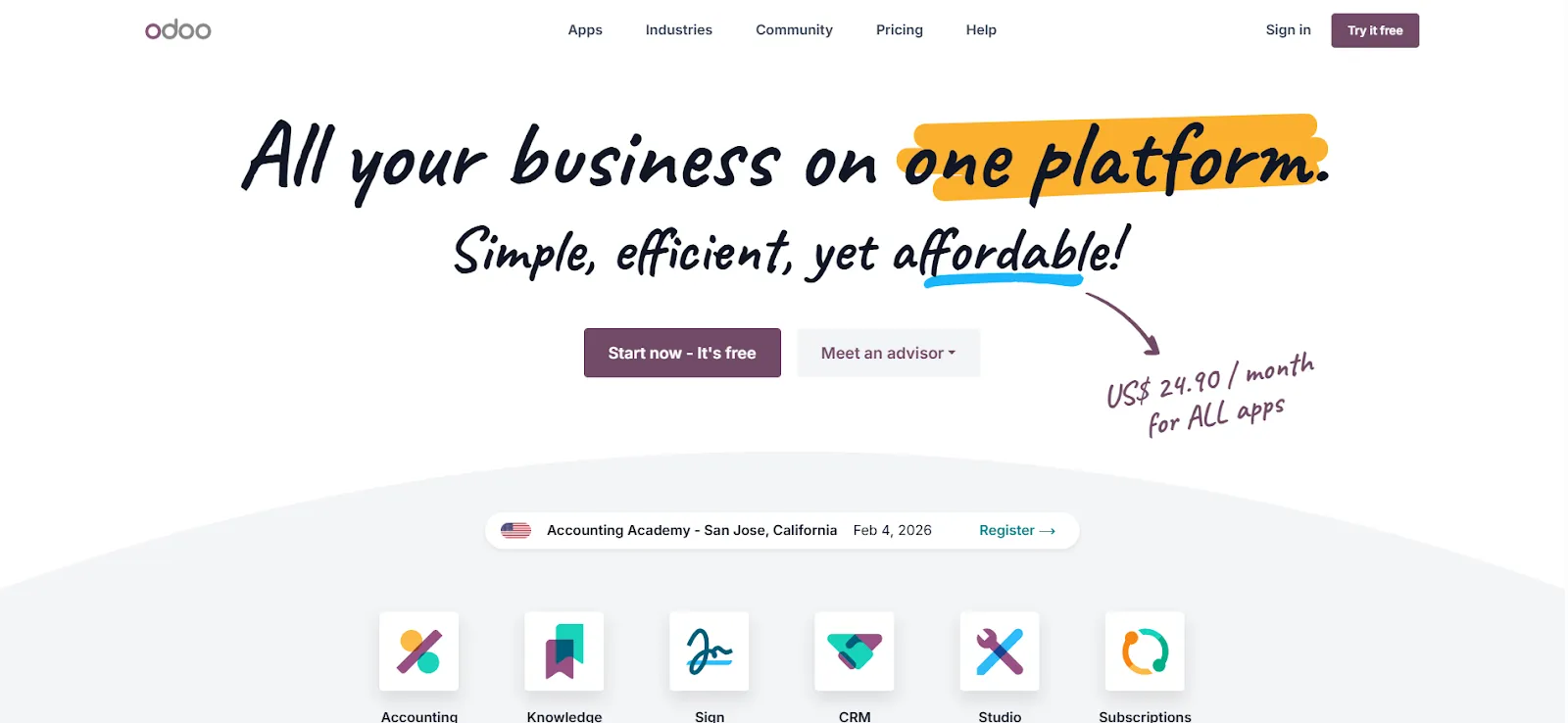
The total cost of Odoo goes beyond the monthly subscription fee. Your true cost of ownership (TCO) includes one-time setup work and recurring operational expenses. These are the main cost categories to plan for.
One-time Costs
1. Implementation and Configuration: This involves the system design and the basic module setup to align Odoo with your business workflows.
2. Data Migration: The cost of this service usually depends on the quality of your legacy systems and the volume of data to be moved.
3. Custom Module Development: Cost here is primarily determined by the developer. Professionals charge strictly based on their level and location, usually at an hourly rate.
Recurring Costs
4. Licensing Fees (for Odoo Enterprise users): Odoo Enterprise is priced per internal user. Check Odoo’s pricing page for current regional rates and billing options.
5. Hosting Infrastructure: Whether you’re using cloud or on-premise hosting, it constitutes a recurring expense. If you’re going the self-hosted route, our How to Install Odoo with Docker on Ubuntu 24.04 guide walks through the setup. To keep raw-VPS pricing without running the server yourself, Cloudpepper’s Odoo VPS hosting manages the infrastructure for a predictable monthly fee.
6. Ongoing Support and Maintenance: Continuous maintenance activities, such as debugging and functional changes, also contribute to recurring costs.
7. Upgrades and Version Migrations: Odoo releases new versions each year. You must refactor your custom code to work with the most recent version, and this incurs some costs.
8. Training and Onboarding: While onboarding can be a one-time cost, training and its associated costs are recurring. It is a proactive activity to prevent long-term costs from errors or abandonment of systems.
Odoo Hosting Costs
If you’re running a custom Odoo plan, hosting is one of the few recurring costs you can actively control. The table below compares common Odoo hosting options, their pricing models, and where each one fits:
| Hosting Provider | Pricing Model | Best For | Estimated Monthly Cost | Limitations |
| Odoo Online (SaaS) | Added to license | Small Enterprises | $0 | No custom codes |
| Odoo.sh | Per Worker / Shared | Custom Enterprise | $60 – $1,000+ | High storage surcharges |
| Cloudpepper (DevOps) | Flat Platform Fee | Scaling SMBs & Odoo partners and hosting providers | $29 – $250 + Server | Requires a server provider |
| Cloudpepper (Server included) | Flat Platform Fee | Scaling SMBs & Odoo partners and hosting providers | $41 – $394 | Less infrastructure control |
| AWS / Azure | Per Resource / Egress | Large Enterprise | $150 – $2,000+ | Requires high DevOps investment |
| Unmanaged VPS | Raw Server Cost | DIY Developers | $10 – $100 | There is no support |
Cloudpepper for Predictable Hosting Costs
Cloudpepper is a hosting option for growing businesses and Odoo management agencies that want managed operations without Odoo.sh-style infrastructure pricing. You keep the cost efficiency of self-hosting while Cloudpepper handles the Odoo operations layer.
Cloudpepper offers:
- No worker tax: While Odoo.sh charges per worker, Cloudpepper lets you run unlimited users on the server capacity you choose. This can save up to 80% of hosting costs compared to Odoo.sh.
- Lower storage costs: Odoo.sh charges separately for production, staging, and backups. Cloudpepper can connect to affordable S3-compatible storage instead.
- White-labeling: Odoo agencies can use their own logo and domain on the management interface, giving clients a branded experience.
- Less vendor lock-in: With Cloudpepper DevOps, you keep root access and data ownership. If you stop using the service, your Odoo instances remain live on your own servers.
- Predictable platform fees: The Pro and Agency plans offer unlimited Odoo servers and instances for a single flat monthly fee, which helps agencies price recurring support more cleanly.
How Much Does Odoo Really Cost? 6 Examples
To make Odoo pricing easier to understand, it helps to look at concrete scenarios. These examples show how user count, implementation scope, and infrastructure decisions change the total.
Note that all figures in this section are estimated costs.
Example 1: The Small E-Commerce Startup (5 Users)
Profile: An online boutique retailer moving from Shopify and QuickBooks to a unified Odoo system to solve “inventory-accounting” drift.
Implementation Strategy: Using the “Out of the Box” strategy with minor configuration. The focus is on the Website, eCommerce, Sales, and Accounting modules.
Technical Nuance: They require the Custom Plan despite their size because they need to install a third-party shipping connector (DHL) from the Odoo App Store — not allowed on Odoo Online.
Cost Breakdown:
- Licensing: ~$1,800/yr (Annual Custom Plan).
- Hosting (Cloudpepper): $348/yr (Basic Platform) + $120/yr (Vultr 2GB RAM Server). Total: $468/yr.
- Implementation: $5,000 (Odoo Partner Success Pack for data import and tax configuration).
- Total Year 1: $7,268.
Example 2: Growing Professional Services Agency (25 Users)
Profile: A digital agency or consultancy seeking to combine Jira for projects, HubSpot for CRM, and Harvest for time-tracking.
Implementation Strategy: Focus on CRM, Project, Timesheets, and Marketing Automation.
Technical Nuance: This client requires Cloudpepper Pro because they need a permanent staging environment. Agencies often tweak project workflows; testing these in a sandbox prevents breaking the production timesheet system used for payroll.
Cost Breakdown:
- Licensing: $9,000/yr (25 Users).
- Hosting (Cloudpepper): $588/yr (Pro Platform) + $480/yr (Compute-optimized server for fast CRM searches). Total: $1,068/yr.
- Implementation: $15,000 (Detailed business process mapping and automated lead-scoring setup).
- Total Year 1: $25,068.
3. Mid-Market Manufacturing Firm (60 Users)
Profile: A hardware manufacturing company requiring high-frequency updates across MRP, PLM, Quality, and Inventory.
Implementation Strategy: Strategic deployment. They use Odoo to track work orders on the shop floor via tablets.
Technical Nuance: Performance is critical. They host on a dedicated server via Cloudpepper. By avoiding shared cloud resources, they reduce the risk that heavy MRP runs, such as calculating material needs for thousands of parts, slow down.
Cost Breakdown:
- Licensing: $21,600/yr (60 Users).
- Hosting (Cloudpepper): $588/yr (Pro) + $1,200/yr (Dedicated Hardware). Total: $1,788/yr.
- Implementation: $50,000 (IoT integration for scales/printers and complex bill-of-materials migration).
- Total Year 1: $73,388.
4. Multi-Location Retail Chain (100 Users)
Profile: 10+ retail locations requiring a unified backend but localized Point of Sale (POS) performance.
Implementation Strategy: Using a multi-Instance strategy. Each large store has its own localized Odoo instance to ensure POS stability if the main internet line flickers.
Technical Nuance: They use the Cloudpepper Agency Plan. This allows the central IT team to manage 10 databases from a single dashboard and push updates to all stores simultaneously.
Cost Breakdown:
- Licensing: $33,000/yr (Volume discount tier).
- Hosting (Cloudpepper): $3,000/yr (Agency Plan) + $2,400/yr (Server Cluster). Total: $5,400/yr.
- Implementation: $100,000 (Hardware sync, on-site staff training, and warehouse routing).
- Total Year 1: $138,400.
5. Specialized Healthcare Implementation (White-Label)
Profile: An agency providing specialized Odoo setups for dental or private clinics.
Implementation Strategy: Focus on Appointments, Document Management, and HIPAA-compliant data handling.
Technical Nuance: Branding is everything here. The agency uses Cloudpepper’s White-Labeling to hide the hosting layer. The doctor sees a portal branded with the Agency’s name, justifying a higher managed service fee.
Cost Breakdown:
- Licensing: $7,200/yr (20 Users).
- Hosting: Integrated into the Agency’s flat Cloudpepper fee.
- Agency Revenue: The agency charges $500/mo for Secure Managed ERP, creating high-margin recurring revenue.
6. High-Volume Wholesale Distributor (40 Users)
Profile: A B2B distributor with 50,000+ SKUs and heavy Electronic Data Interchange (EDI) requirements.
Implementation Strategy: Focus on Warehouse Management and Purchase.
Technical Nuance: Because they process thousands of API calls daily from shipping carriers and Amazon/Walmart, hosting on Odoo.sh would cost thousands in worker surcharges. On Cloudpepper, they pay for the server size, not the API traffic volume.
Cost Breakdown:
- Licensing: $14,400/yr.
- Hosting (Cloudpepper): $588/yr (Pro) + $960/yr (High-speed NVMe server). Total: $1,548/yr.
- Implementation: $35,000 (Custom EDI mapping and barcode scanner optimization).
- Total Year 1: $50,948.
Cost Optimization Strategies: How to Reduce Your TCO
You can reduce Odoo costs without weakening the system if you focus on the recurring cost drivers: hosting, licensing, customization, and maintenance.
1. Optimize Your Hosting
Hosting is one of the most flexible parts of Odoo cost. Choosing the right hosting model can reduce recurring spend without changing your Odoo license. For a side-by-side look at the top options, see our Best Odoo Hosting Platforms in 2026 guide.
2. Employ Strategic Licensing Management
Licensing fees are one of the recurring expenses that add up quickly. Start by checking annual billing. Odoo provides a 20% discount for Enterprise licenses billed annually, so annual billing can reduce your license cost.
You can also negotiate multi-year contracts for longer-term discounts. This may also protect you against price increases during the contract period.
Your user count also affects your total monthly bill. While portal users are free, Odoo charges licensing for each internal user. To optimize licensing costs, regularly audit users and archive inactive accounts to reduce your overall license costs.
3. Ensure Implementation and Development Efficiency
How you implement Odoo also affects your cost. Use a phased rollout instead of launching every module at once. For an ecommerce business, that may mean starting with Sales and Accounting, then adding more modules after the core workflow is stable.
You can also save money by keeping customization tight. Wherever possible, use Odoo’s standard features. This reduces the initial development bill and lowers future upgrade costs.
Invest in a few internal “super users.” Training a small group well can reduce consultant dependency for daily support, configuration, and internal workshops.
4. Optimizing Technical DevOps
Cloudpepper can handle much of the technical DevOps work without requiring a full-time internal DevOps hire. The platform can assist with security updates, backups, and SSL management.
Cloudpepper also lets you create master templates for preconfigured Odoo databases. For agencies, these templates can reduce repeated setup work when onboarding new clients.
Hidden Costs to Watch Out For
Odoo’s license pricing is relatively transparent, but ERP projects still create secondary costs as they grow. The common ones are upgrades, infrastructure, third-party modules, data cleanup, and in-app credits.
For agencies, these costs matter because they directly affect support margins and client expectations.
a. Upgrade and Refactoring Costs
Every year, Odoo releases a new version of its ERP system. Although your core license includes these annual updates, your customizations still need review. Heavy customization can create technical debt, especially after two or three missed upgrades. A major rewrite can create costs you did not budget for.
Odoo has also implemented a 25% support surcharge for databases on outdated versions from three releases behind. Besides the technical debt, you’ll also be accumulating financial costs.
Even if the surcharge does not apply, skipped versions can increase migration work. It is estimated that migration cost increases by about 1.5 times for each version you miss.
These costs pose a high risk, and you can reduce these hidden costs with minimal customization and by using Odoo Studio.
b. Infrastructure Overcharges
On official platforms such as Odoo.sh, costs can rise as your business grows because storage, workers, and staging environments are priced separately.
The most common are storage charges. As your business volume increases with more documents, images, and attachments, your storage costs begin to spike on par with your growth.
Similarly, the system may insist on buying additional workers as traffic and user activity increase, or risk slower system speeds. Staging environment fees also add up silently during development. Testing branches on Odoo.sh costs about $18 per environment per month. This cost multiplies over time and increases with more environments engaged.
c. Third-Party App and Module Lifecycle
Hidden costs may also arise from integrated apps and modules, due to maintenance requirements or even decay. Many applications on the Odoo App Store are sold as one-time purchases, but with limited support (90 days). After this free support period, if an issue or bug arises, you must pay the developer for a new version or a fix. You may also need a new version when you upgrade your Odoo.
There is a constant risk from this source, but you can mitigate it with a Service Level Agreement (SLA) with your partners.
d. Data Hygiene and Cleansing
Data migration can take a lot of time when legacy data is messy. Successful migration requires proper cleaning before import. The lower the quality of legacy data, the more time it takes to clean, and the higher the cost.
Data validation is also another time-consuming process. Experts spend considerable time ensuring that migrated balances match the legacy system. Underestimating this process may later require costly consultation in critical times.
e. In-App Purchase Credits
Some automated services on Odoo, such as SMS & Marketing, Lead generation, and Document digitization, use a pay-as-you-go model. Using these services requires credits that increase as your activities grow, generating costs beyond your regular budget.
Conclusion
Odoo cost cannot be judged by the license price alone. Cheap entry points can hide long-term operational costs, while all-in-one hosted platforms can become expensive as storage, workers, and environments grow.
Odoo’s price largely depends on the choices around it. You can control costs by separating hosting management from the software license and choosing infrastructure that lets data volume and user activity grow without a matching jump in platform fees. If you’re comparing Odoo against other ERPs before committing, our Odoo vs ERPNext and Odoo vs. Salesforce comparisons can help.
Cloudpepper helps keep Odoo hosting predictable by separating platform management from the software license and giving teams more control over infrastructure costs.