Odoo vs ERPNext: Practical Comparison
Compare Odoo and ERPNext on pricing, hosting, features, customization, deployment, scalability, support, and fit for different teams.
Choosing ERP software in 2026 usually comes down to fit: how many processes you need to centralize, how much customization you expect, and who will maintain the system.
Odoo and ERPNext are two widely used open-source ERP options. Both cover accounting, inventory, sales, HR, manufacturing, and procurement, but they make different trade-offs.
Odoo has the larger app marketplace, broader commercial ecosystem, and more deployment options. ERPNext is simpler, fully open-source, and often easier for smaller technical teams to reason about.
This article compares Odoo and ERPNext across pricing, hosting, features, customization, deployment, scalability, and support.
What these ERPs are and who uses them
Odoo
Odoo is a modular ERP platform with apps for CRM, eCommerce, accounting, manufacturing, inventory, HR, and project management. It has both a free Community edition and a paid Enterprise edition.
Who uses Odoo:
- Small to large organizations seeking a scalable, integrated suite
- Businesses that want extensibility with a large third-party app ecosystem
- Companies with specific workflow needs that require customization
ERPNext
ERPNext is an open-source ERP built on the Frappe framework, emphasizing simplicity, affordability, and ease of use. It offers a full stack of business modules, including finance, HR, manufacturing, CRM, and inventory. ERPNext is known for its clean interface and strong community focus.
Who uses ERPNext:
- Small and medium-sized enterprises (SMEs)
- Organizations preferring open-source solutions without heavy licensing costs
- Teams that value a straightforward, all-in-one ERP without excessive customization overhead
Odoo vs ERPNext – Overview
At a high level, the main trade-off is customization and ecosystem versus simplicity and open-source control:
| Aspects | Odoo | ERPNext |
| Licensing Model | Community (free) + Enterprise (paid per user) | Fully open-source (free), paid only for hosting/support |
| Customization | Very high (extensive modules & third-party apps) | Moderate (configurable, fewer extensions) |
| User Experience | Flexible but can be complex | Simpler and more streamlined |
| Ecosystem & Market | Larger community and marketplace | Smaller but tightly integrated ecosystem |
| Best For | Businesses needing deep customization and scalability | SMEs seeking affordability and simplicity |
Pricing & Licensing
While both Odoo and ERPNext are open-source at their core, their total cost structures differ based on hosting, licensing, and ongoing maintenance.
The comparison below highlights the real-world monthly costs to help you evaluate overall value, not just license fees.
Odoo
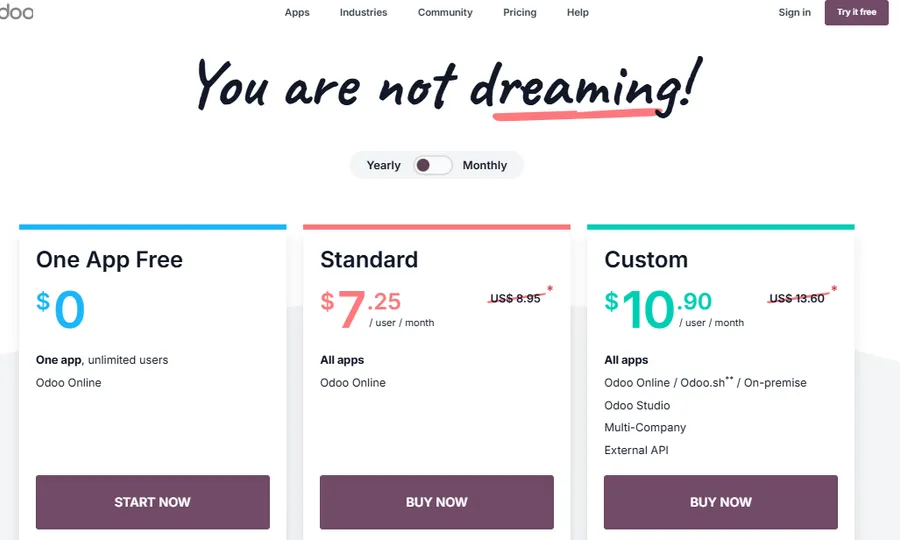
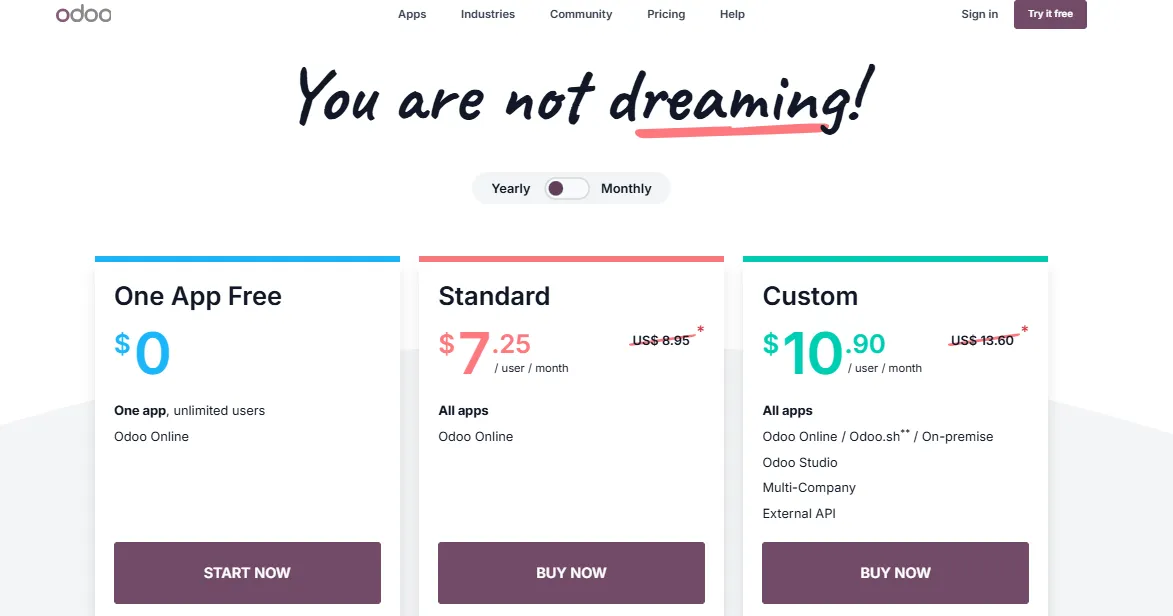
Odoo offers a One App Free plan and paid Standard and Custom plans. Pricing varies by region, billing term, and promotion, so check Odoo’s pricing page for current rates. The Custom plan is the relevant tier when you need Odoo Studio, multi-company support, external API access, Odoo.sh, or self-hosted Enterprise deployments. The Community edition stays free to license; you can self-host it or use managed Odoo Community hosting so you carry the hosting cost without running servers yourself.
ERPNext
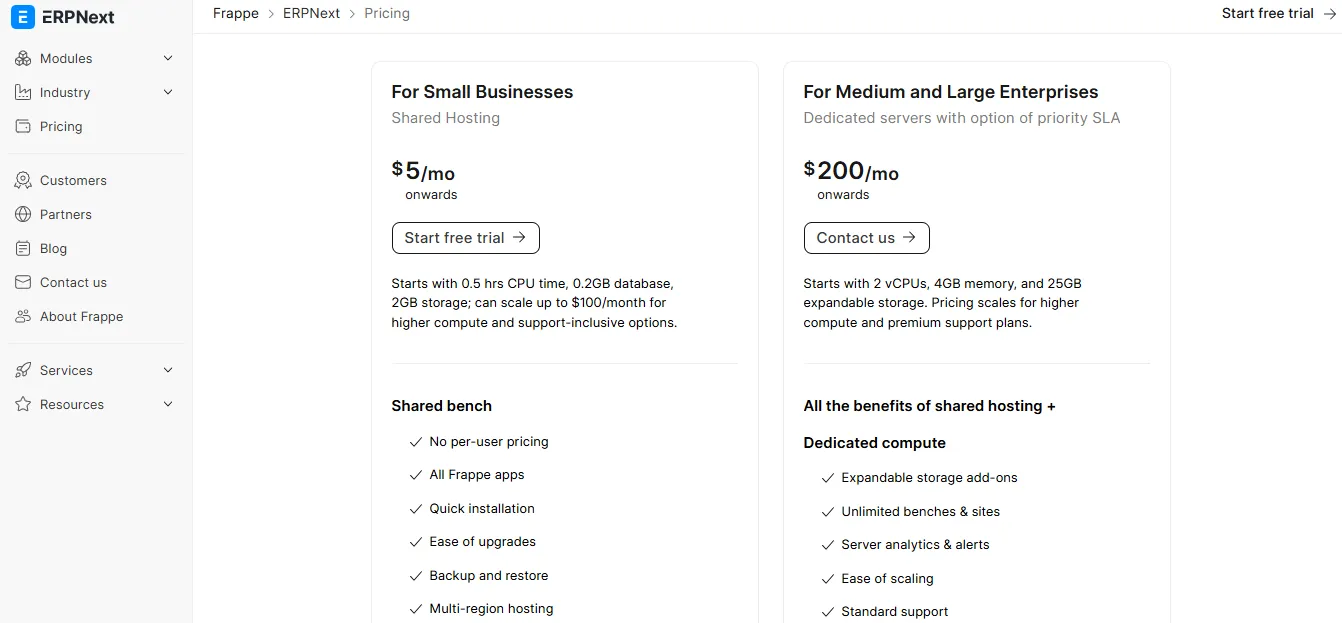
ERPNext is free and open-source, with hosting on Frappe Cloud starting at $5/month for small businesses and $200/month for enterprises. Plans include shared or dedicated servers with easy setup, backups, upgrades, multi-region hosting, and optional premium support for enterprise deployments.
| Cost Element | Odoo + Hosting (Cloudpepper) | ERPNext + Hosting (Self-Managed VPS) |
| Software License | Community: free. Enterprise: per-user pricing varies by region and billing term. | Always free and open-source. |
| Hosting | Cloudpepper managed hosting starts at $41/month with server included. | Frappe Cloud or VPS hosting, plus internal maintenance time for self-managed setups. |
| Support & Maintenance | Optional paid support or partner services. | Included in Frappe Cloud plans; enterprise services available for SLA-backed support. |
| Customization & Upkeep | Odoo Studio, marketplace modules, and a large developer ecosystem. | Requires internal developer support for advanced customization. |
| Total Cost Reality | Cloudpepper hosting plus any Odoo Enterprise license cost. | Hosting plus internal maintenance time. |
Note: ERPNext’s self-hosted software is free, but total ownership cost includes hosting, maintenance, and DevOps time. Check Frappe Cloud for current managed hosting prices.
Core Features Comparison
Both Odoo and ERPNext cover the essential ERP modules, but they differ in depth, flexibility, and scalability across key business functions.
The table below shows where each platform is usually stronger.
| Features | Odoo | ERPNext |
| Accounting & Finance | More polished, with advanced reporting, automation, and multi-company support. | Solid accounting fundamentals covering invoicing, ledgers, taxes, and financial reports. |
| Inventory Management | Handles complex inventory workflows, multi-warehouse setups, barcode scanning, and advanced routing. | Reliable inventory features for standard stock management and warehouse needs. |
| CRM & Sales | Strong CRM with pipelines, lead scoring, automation, and deep sales integration. See our Odoo vs. Salesforce and Odoo vs. HubSpot comparisons. | Functional CRM suitable for basic sales tracking and customer management. |
| Manufacturing | Capable and scalable, but often requires configuration or add-ons for advanced manufacturing flows. | Strong native manufacturing features, including BOMs, work orders, and production planning. |
| HR & Payroll | Broader HR suite with recruitment, appraisals, attendance, and advanced payroll options. | Covers core HR needs such as employee records, attendance, and basic payroll. |
| eCommerce Integration | Built-in eCommerce, website builder, and ERP integration. | Limited native eCommerce capabilities; often relies on third-party tools. |
User Interface & Ease of Use
Odoo
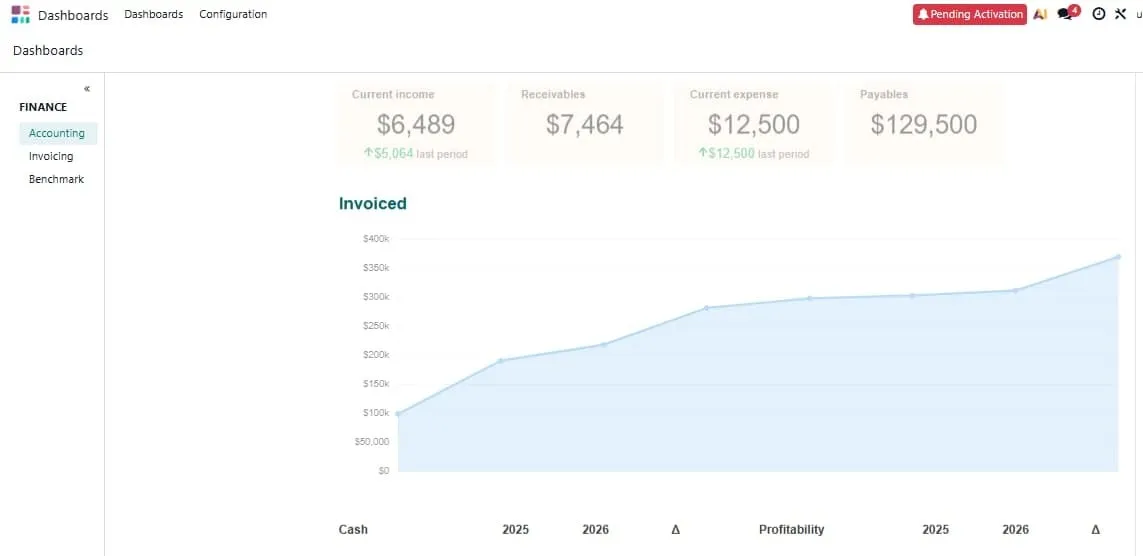
- Features a modern, polished interface for daily business work.
- Dashboard includes dynamic charts, KPIs, and customizable views across modules.
- Navigation feels familiar to users coming from modern SaaS tools.
- Offers a strong mobile experience with responsive design and dedicated mobile apps.
ERPNext
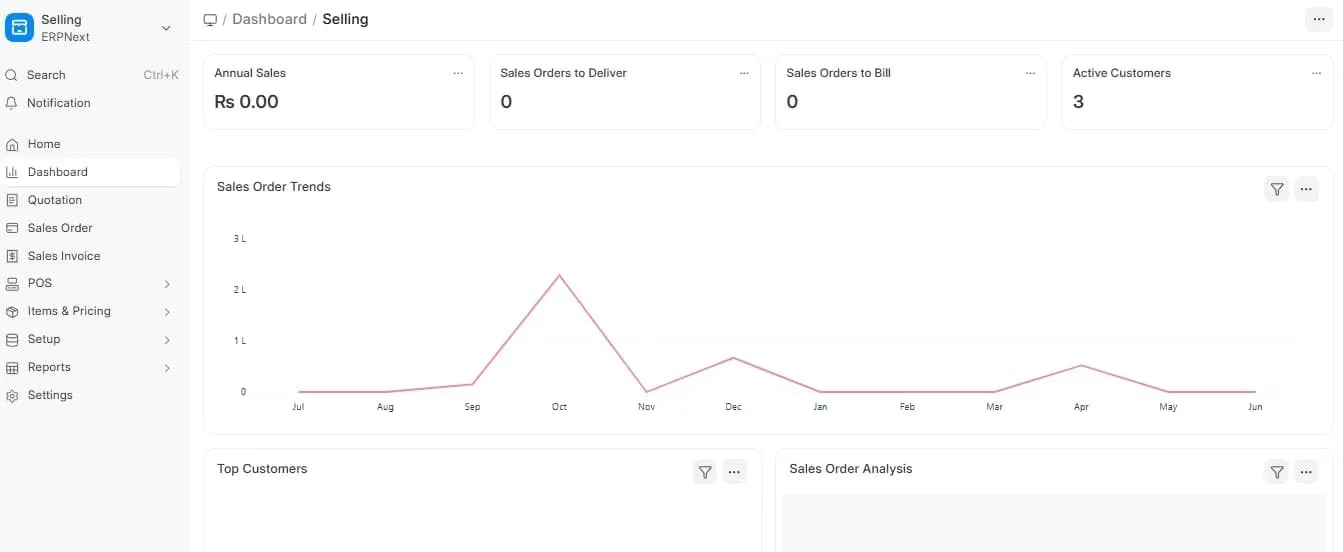
- Provides a simple, clean, and functional interface focused on core business tasks.
- Fewer on-screen features reduce clutter and make it easier for first-time users.
- Dashboards emphasize data tables and reports over visual widgets.
- Mobile access is available but less refined compared to Odoo’s mobile apps.
Ecosystem & Integrations
Odoo
Odoo has one of the largest ERP ecosystems in the market, with modules from Odoo SA and third-party partners. This makes it easier to extend accounting, sales, manufacturing, marketing, and industry-specific workflows.
With platforms like Cloudpepper, businesses also get access to pre-vetted Odoo add-ons, which can reduce compatibility risk during deployment.
According to user reviews, Odoo users value that everything is in one place, allowing them to manage accounting, sales, products, and employees without needing multiple programs.
ERPNext
ERPNext, on the other hand, takes a more controlled and focused approach. Its ecosystem is smaller, but most features are built and maintained by a single core team, ensuring tight integration, consistency, and fewer conflicts between modules.
This makes ERPNext easier to maintain over time, especially for teams that value stability over customization depth.
According to user reviews, “ERPNext users appreciate that it is open-source, highly customizable, and covers most business processes in a single system, making it a cost-effective and flexible solution for growing businesses”.
Customization & Development
- Odoo: Offers Odoo Studio for no-code customization, along with developer tools for advanced use cases.
- ERPNext: Takes a developer-first approach with a clean and accessible codebase.
- ERPNext Advantage: Simpler architecture, making it easier to understand, customize, and maintain.
- Odoo Advantage: More development resources available and a much larger global developer community.
Deployment & Hosting Options
Odoo hosting
Cloudpepper Managed Hosting
Best for growing teams that want managed Odoo hosting, fast deployment, staging environments, and predictable pricing without building an internal DevOps process first.
Cloudpepper DevOps (Bring Your Own Infrastructure)
Best when a company already uses cloud infrastructure such as AWS, Google Cloud, Azure, DigitalOcean, or Vultr, but does not want to manage Odoo operations directly. You keep control of the infrastructure while Cloudpepper handles Odoo installation, updates, monitoring, and performance work.
Odoo.sh (Official Platform)
Odoo.sh is Odoo’s native hosting platform for Git-based development workflows and CI/CD. It is useful for development teams, but infrastructure costs can rise as workers, storage, and staging environments increase.
Self-Hosted Odoo
Self-hosting gives you the most control and the lowest direct platform cost, but it requires technical knowledge to install, secure, upgrade, and tune Odoo. Our How to Install Odoo with Docker on Ubuntu 24.04 guide walks through the full setup. This option is best for experienced DevOps teams.
ERPNext hosting
ERPNext has fewer hosting paths, which can make the decision simpler.
Frappe Cloud is the most straightforward choice for many ERPNext users. It is closely tied to the ERPNext ecosystem and works well for small and mid-size teams that do not want to manage infrastructure.
Self-hosted ERPNext gives technical teams full control without tying them to a managed platform. The trade-off is that your team owns backups, upgrades, security, monitoring, and performance tuning.
ERPNext has fewer third-party managed hosting vendors than Odoo. That can make the market easier to understand, but it also means fewer managed-service options if you want to outsource operations.
Use Cases
Use Case 1: Small Retail / eCommerce Business (10 -50 Employees)
Winner: Odoo
Odoo is often the better option for retail and ecommerce businesses. It has native eCommerce, POS, inventory, and accounting modules that work together.
With Cloudpepper, teams can deploy Odoo with lower operational overhead and spend more time on the business workflow.
ERPNext can support simple retail operations, but its ecommerce features are more limited and may require more customization or third-party tools.
Use Case 2: Manufacturing Company (50 -150 Employees)
Slight Edge: Odoo
Odoo is more mature for complex planning, multi-location workflows, and hosting flexibility. Its larger ecosystem also makes it easier to extend functionality as processes become more complex.
That said, ERPNext remains a viable option in this segment. It offers solid core manufacturing capabilities, such as BOMs, work orders, inventory, and costing, and works well for manufacturers with straightforward production processes and limited budgets.
Use Case 3: Simple Service Business (Extremely Budget-Conscious)
The winner depends on priorities.
ERPNext is a reasonable, practical choice when cost is the main constraint and the team has enough technical capability internally. It covers invoicing, simple CRM, project tracking, and core operations without per-user licensing pressure.
When time, usability, and faster setup matter more than the lowest possible software cost, Odoo with managed hosting can be the better fit for non-technical teams.
Scalability & Performance
Odoo
Odoo is used by large organizations and can support more complex, multi-company deployments. Its modular structure and wider hosting ecosystem make it a stronger fit for businesses expecting growth or heavier operational workloads.
Scalability is easier to manage with Cloudpepper, where dedicated resources, staging environments, and performance tuning help reduce infrastructure bottlenecks.
ERPNext
ERPNext is reliable for small and mid-size organizations with steady, well-defined workloads. It can scale vertically and horizontally, but it is not as commonly used at large enterprise scale as Odoo.
Self-hosting ERPNext gives technical teams flexibility over cost and performance, but it also adds operational responsibility.
Support & Community
- Odoo: Large international community, thousands of partners, and extensive documentation.
- ERPNext: Smaller community, responsive forum, and strong documentation.
- Cloudpepper (Odoo): Odoo-specific 24/7 support.
- ERPNext: Solid community backing, but a smaller commercial support network than Odoo.
Pros and Cons
Odoo
Pros
- Broad feature ecosystem across CRM, Sales, Accounting, Inventory, POS, eCommerce, HR, Projects, and more.
- Modern interface with frequent updates.
- Large integrations marketplace for third-party apps and extensions.
- Strong partner and support network with many certified implementers.
Cons
- Enterprise licensing can become expensive as the user count grows.
- Deeper customization may require partner or developer support.
ERPNext
Pros
- Economical and lean, especially when self-hosted.
- Fully open-source, with freedom to edit and self-manage.
- Straightforward processes for accounting, inventory, and manufacturing.
- Flexible for technical teams that can maintain it.
Cons
- Less polished UX than Odoo.
- Smaller integration and app ecosystem.
- Self-hosted setups require technical expertise.
- Weaker advanced ecommerce features for multi-channel retail.
Decision Framework
Choose Odoo + Cloudpepper if your business:
- Is in a growth phase and expects evolving process needs
- Values time over tinkering; you want practical results, not DIY complexity
- Needs eCommerce + POS as a core part of operations
- Wants a modern UX with frequent feature releases & improvements
- Depends on extensive integrations (CRM, MRP, eCommerce, HR, accounting, apps marketplace)
- Prefers a large ecosystem & partner network for support, custom apps, and extensions
- Wants a system that can scale across departments without heavy technical maintenance
Choose ERPNext if your business:
- Is very budget-conscious and has internal technical skills
- Has simple manufacturing/operations needs
- Prefers a focused feature set over a broad marketplace of integrations
- Is comfortable with self-hosted infrastructure and some DIY configuration
Conclusion
Odoo is the stronger fit when you need a broad ERP ecosystem, a large app marketplace, and flexible hosting options. ERPNext is the stronger fit when you want a fully open-source ERP with a simpler footprint and you have the technical team to manage it.
If you choose Odoo but do not want to manage every server detail internally, managed hosting like Cloudpepper can keep performance, backups, security, and support in one operational layer. Try Odoo with Cloudpepper’s free trial when you want to test that path before committing.