

Choosing the right Enterprise Resource Planning (ERP) software in 2026 has become a critical decision for businesses looking to streamline operations, improve visibility, and scale efficiently.
With leading platforms like SAP, NetSuite, Microsoft Dynamics 365, Odoo, and ERPNext available, navigating the ERP landscape can feel complex.
Among these options, Odoo and ERPNext are widely adopted open-source ERP solutions. Both help businesses centralize core functions such as accounting, inventory, sales, HR, manufacturing, and procurement into a single system. However, they differ significantly in their approach, flexibility, ecosystem, and ideal use cases.
According to the Global Growth Insight, the global ERP software market was valued at around USD 61.15 billion in 2024 and is projected to grow to over USD 131 billion by 2033 at a CAGR of about 8.85 %.
This guide compares Odoo and ERPNext, highlighting their key differences and strengths, and provides insights for businesses evaluating scalable, modular, and cost-effective ERP solutions in 2026.
What these ERPs are and who uses them
Odoo
Odoo is a comprehensive, modular ERP platform that combines a suite of business applications ranging from CRM, eCommerce, and accounting to manufacturing and project management. It is designed to be highly flexible and customizable, with both community (open-source) and enterprise (paid) editions.
Who uses Odoo:
- Small to large organizations seeking a scalable, integrated suite
- Businesses that want extensibility with a large third-party app ecosystem
- Companies with specific workflow needs that require customization
ERPNext
ERPNext is an open-source ERP built on the Frappe framework, emphasizing simplicity, affordability, and ease of use. It offers a full stack of business modules, including finance, HR, manufacturing, CRM, and inventory. ERPNext is known for its clean interface and strong community focus.
Who uses ERPNext:
- Small and medium-sized enterprises (SMEs)
- Organizations preferring open-source solutions without heavy licensing costs
- Teams that value a straightforward, all-in-one ERP without excessive customization overhead
Odoo vs ERPNext – Overview
At a high level, the primary distinction between Odoo and ERPNext lies in customization and ecosystem versus simplicity and open-source purity:
| Aspects | Odoo | ERPNext |
| Licensing Model | Community (free) + Enterprise (paid per user) | Fully open-source (free), paid only for hosting/support |
| Customization | Very high (extensive modules & third-party apps) | Moderate (configurable, fewer extensions) |
| User Experience | Flexible but can be complex | Simpler and more streamlined |
| Ecosystem & Market | Larger community and marketplace | Smaller but tightly integrated ecosystem |
| Best For | Businesses needing deep customisation and scalability | SMEs seeking affordability and simplicity |
Pricing & Licensing
While both Odoo and ERPNext are open-source at their core, their total cost structures differ based on hosting, licensing, and ongoing maintenance.
The comparison below highlights the real-world monthly costs to help you evaluate overall value, not just license fees.
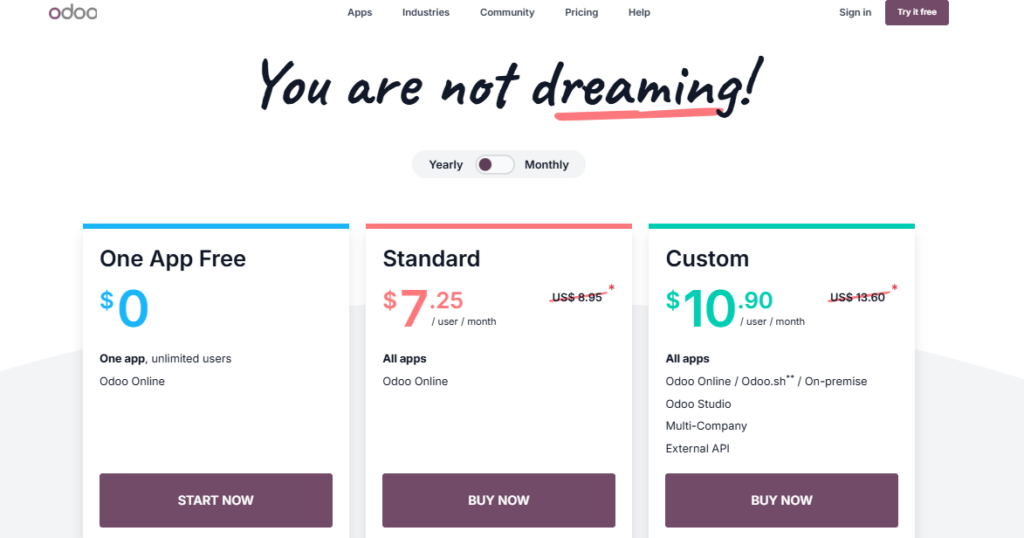
Odoo
Odoo offers flexible pricing, starting with One App Free ($0) for unlimited users. For full access to all apps, choose Standard ($7.25/user/month) or Custom ($10.90/user/month) with advanced features like Studio, multi-company support, and external API access.
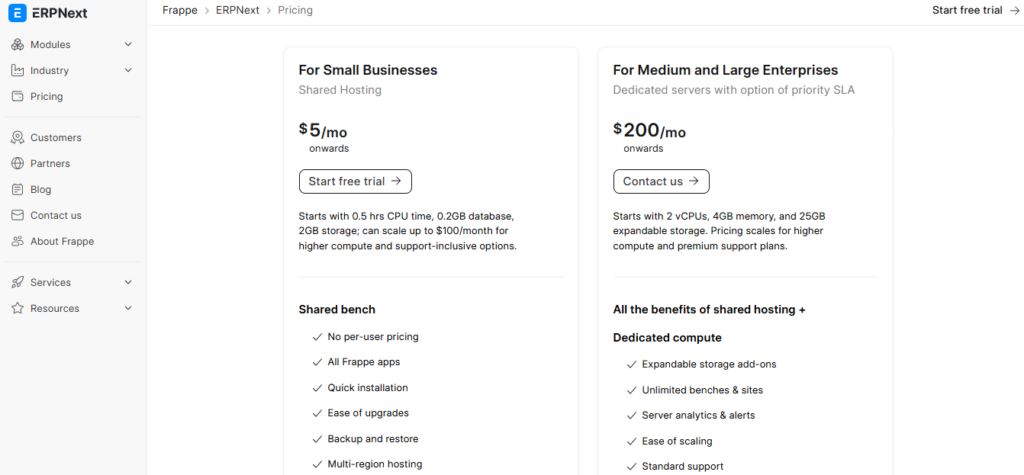
ERPNext
ERPNext is free and open-source, with hosting on Frappe Cloud starting at $5/month for small businesses and $200/month for enterprises. Plans include shared or dedicated servers with easy setup, backups, upgrades, multi-region hosting, and optional premium support for enterprise deployments.
| Cost Element | Odoo + Hosting (Cloudpepper) | ERPNext + Hosting (Self-Managed VPS) |
| Software License | Community: $0 (free)Enterprise: 7.5$-10.90$/user/mo | Always free (open-source) |
| Hosting | Cloudpepper Managed Hosting: $41/month (all-in-one Odoo + support) | Frappe Cloud Shared Hosting:$5–$200/monthVPS: $44+/month + internal maintenance |
| Support & Maintenance | Optional paid support or partner services | Included in Frappe Cloud plans; Enterprise Services available for SLA-backed support |
| Customization & Upkeep | Easy via Odoo Studio, marketplace modules, and developer resources | Requires internal developer support for advanced customization |
| Total Cost Reality | ~$41/month for Cloudpepper hosting + license/user | $44+/month for VPS hosting + internal maintenance time |
Note: ERPNext’s self‑hosted software is free, but total ownership cost includes hosting, maintenance, and DevOps time. Managed ERPNext hosting on Frappe Cloud starts at $5/month for small sites and can scale up to $200/month or more for dedicated servers.
Core Features Comparison
Both Odoo and ERPNext cover the essential ERP modules, but they differ in depth, flexibility, and scalability across key business functions.
The table below provides a fair, side-by-side comparison to help you quickly understand where each platform excels.
| Features | Odoo | ERPNext |
| Accounting & Finance | More polished and feature-rich with advanced reporting, automation, and multi-company support | Solid accounting fundamentals covering invoicing, ledgers, taxes, and financial reports |
| Inventory Management | Handles complex inventory workflows, multi-warehouse setups, barcode scanning, and advanced routing. | Reliable inventory features for standard stock management and warehouse needs. |
| CRM & Sales | Strong CRM with pipelines, lead scoring, automation, and deep sales integration. | Functional CRM suitable for basic sales tracking and customer management. |
| Manufacturing | Capable and scalable, but often requires configuration or add-ons for advanced manufacturing flows | Surprisingly strong native manufacturing features, including BOMs, work orders, and production planning. |
| HR & Payroll | More comprehensive HR suite with recruitment, appraisals, attendance, and advanced payroll options | Covers core HR needs such as employee records, attendance, and basic payroll. |
| eCommerce Integration | Clear advantage with built-in eCommerce, website builder, and seamless ERP integration | Limited native eCommerce capabilities; often relies on third-party tools. |
User Interface & Ease of Use
Odoo
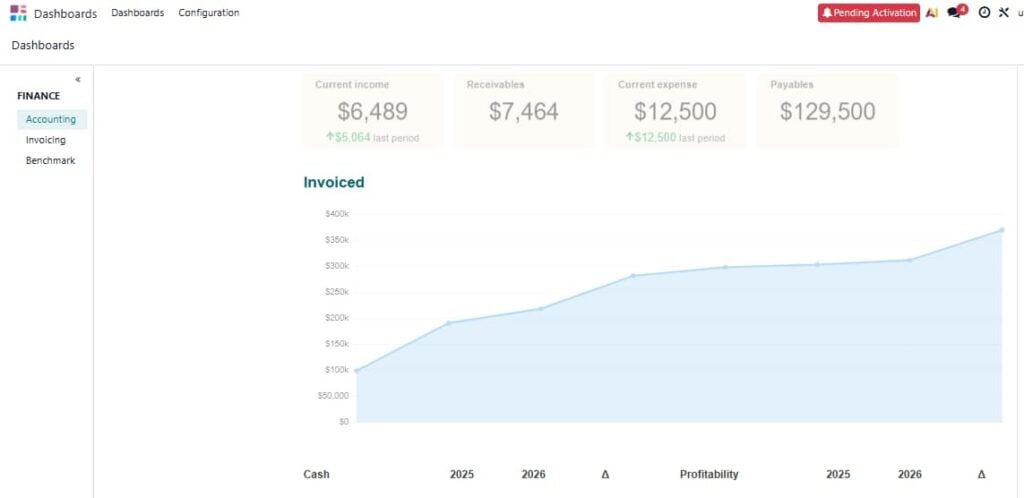
- Features a modern, intuitive, and visually polished interface designed for productivity.
- Dashboard includes dynamic charts, KPIs, and customizable views across modules.
- Navigation feels familiar to users coming from modern SaaS tools.
- Offers a strong mobile experience with responsive design and dedicated mobile apps.
ERPNext
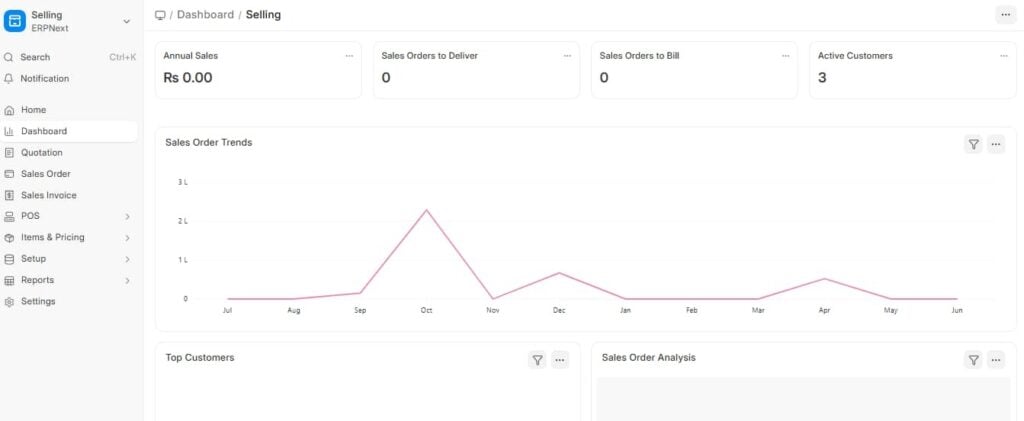
- Provides a simple, clean, and functional interface focused on core business tasks.
- Fewer on-screen features reduce clutter and make it easier for first-time users.
- Dashboards emphasize data tables and reports over visual widgets.
- Mobile access is available but less refined compared to Odoo’s mobile apps.
Ecosystem & Integrations
Odoo
Odoo stands out with one of the largest ERP ecosystems in the market, offering 40,000+ modules developed by Odoo SA and third-party partners. This massive ecosystem makes it easy to extend functionality across accounting, sales, manufacturing, marketing, and industry-specific use cases.
With platforms like Cloudpepper, businesses also get access to 900+ pre-vetted Odoo add-ons, reducing compatibility risks and accelerating deployment.
According to user reviews, Odoo users value that everything is in one place, allowing them to manage accounting, sales, products, and employees without needing multiple programs.
ERPNext
ERPNext, on the other hand, takes a more controlled and focused approach. Its ecosystem is smaller, but most features are built and maintained by a single core team, ensuring tight integration, consistency, and fewer conflicts between modules.
This makes ERPNext easier to maintain over time, especially for teams that value stability over customization depth.
According to user reviews, “ERPNext users appreciate that it is open-source, highly customizable, and covers most business processes in a single system, making it a cost-effective and flexible solution for growing businesses”.
Customization & Development
- Odoo: Offers Odoo Studio for no-code customization, along with powerful developer tools for advanced use cases.
- ERPNext: Takes a developer-first approach with a clean and accessible codebase.
- ERPNext Advantage: Simpler architecture, making it easier to understand, customize, and maintain.
- Odoo Advantage: More development resources available and a much larger global developer community.
Deployment & Hosting Options
Odoo hosting:
Cloudpepper Managed Hosting.
Perfect to use in a business that is fast and hands-off. The option fits well with the growing teams that are concerned with speed, reliability, and limited DevOps work since it has a 5-minute deployment, unlimited staging environments, and predictable pricing ($41/month).
Cloudpepper DevOps (Bring Your Own Infrastructure)
Most suitable when companies are already using cloud infrastructure (AWS, GCP, Azure) but would not like to take care of the Odoo operations directly. You maintain control of the infrastructure, and Cloudpepper takes care of Odoo installation, updates, monitoring, and performance.
Odoo.sh (Official Platform)
The Odoo native hosting system has intensive Git-based workflows and CI/CD. Performance-intensive per the development team, but is much more costly.
Self-Hosted Odoo
Most control and minimum direct costs; however, it takes a lot of technical knowledge to implement, secure, upgrade, and tune the performance. Most suitable for advanced DevOps teams.
ERPNext hosting:
ERPNext is more focused and simple in its hosting strategy, and it has fewer and clearer options.
- Official hosting, Frappe Cloud.
The best choice for the majority of the ERPNext users. It has simple pricing, simple to set up, and is closely knit with the ERPNext ecosystem- so that it is well suited to small and mid-size teams.
- Self-Hosted ERPNext
Documented and comparatively less difficult to implement than most ERPs. It is adequate to use with technical teams that need to have complete control and not be tied to third-party platforms.
- Low numbers of Special Providers.
ERPNext also has less third party hosting vendors.
- Pro: There is less overlap and mixing.
- Cons: The number of managed-service options is lower than the ecosystem offered by Odoo.
Use Cases – Honest Assessment
Use Case 1: Small Retail / eCommerce Business (10 -50 Employees)
Winner: Odoo
Odoo is the better option in retail and e-commerce-based businesses. It has native eCommerce, POS, inventory, and accounting modules that are well integrated and advanced.
With Cloudpepper, it is fast to deploy and has a low operational overhead, which means that teams do not need to work on the infrastructure and can focus on the business.
ERPNext can facilitate simple retailing, but its eCommerce features are modest and, in most cases, may need more customization or third-party applications, making it not the most appropriate choice for expanding online companies.
Use Case 2: Manufacturing Company (50 -150 Employees)
Slight Edge: Odoo
Odoo is more mature, offers greater flexibility in its hosting options, and provides more advanced planning options, which is also greater in scale and multi-location features. Its ecosystem also enables easy functionality extension because processes become more complicated.
That said, ERPNext remains a viable option in this segment. It offers solid core manufacturing capabilities, such as BOMs, work orders, inventory, and costing, and works well for manufacturers with straightforward production processes and limited budgets.
Use Case 3: Simple Service Business (Extremely Budget-Conscious)
The winner depends on priorities.
ERPNext is a reasonable, practical solution in case cost is the key limitation and one possesses the necessary technical capability internally. It includes basic requirements such as invoicing, simple CRM, project tracking, and does not pressurize with licensing.
But when the business takes time, usability, and quicker installation into consideration, as opposed to saving money, Odoo + Cloudpepper is preferable. The less configuration needed, the more intuitive the UX, and the controlled infrastructure usually compensate the increased cost to non-technical teams.
Scalability & Performance
Odoo
Odoo has been tested at the enterprise level, and has millions of users deployed in large organizations all over the world. Its modular structure, regular performance recovery, and expansive hosting environment render it appropriate to business enterprises that anticipate a swift increase or multi-firm functioning.
Scalability is even more simplified when it is hosted at Cloudpepper. Specialized resources, unlimited staging environments, and controlled performance tuning enable teams to scale without issues of infrastructure bottlenecks and risk of deployment.
ERPNext
ERPNext is also a reliable solution in small and mid-size enterprises and is optimally suitable in enterprises whose workload is steady and well-defined. Although it can be scaled vertically and horizontally, it has not been used in large enterprise levels as frequently as Odoo.
ERPNext provides complete flexibility with scaling when using self-hosting. This benefits technical teams who desire to optimize costs and performance and adjust infrastructure fine-tuning, but comes at the cost of more operational responsibility.
Support & Community
- Odoo: A vast international community and thousands of partners, and a large amount of documentation.
- ERPNext: Smaller community that is passionate, responsive forum and has strong documentation.
- Cloudpepper (Odoo): Odoo-specific 24/7 support.
- ERPNext: There is a solid community backing, although overall, there is a lower safety net than Odoo.
Pros & Cons
Odoo:
Pros
- Vast feature ecosystem – good coverage in CRM and Sales, Accounting, Inventory, POS, eCommerce, HR, Projects, etc.
- Contemporary, refined UX Intuitive interface, and continual updates and enhancements.
- Monumental integrations marketplace to connect with 3 rd party apps and extensions easily.
- Existence of strong partner/support network. Certified implementers and professional services are very abundant.
Cons
- Licensing fees may burn a hole in your pocket, particularly where there is more than one application or enterprise version.
- Dependency on customization may need partner support for more intense changes.
ERPNext
Pros
- Economical and lean – cheaper, particularly when self-hosted.
- Uncontaminated open-source philosophy, freedom to edit and self-manage without lock-in to a vendor.
- Raw simple processes, specialized competencies in simple accounting, inventory, and manufacturing.
- Elastic customization (technical) – excellent when you have IT staff.
Cons
- Weaker UX than Odoo – not as fancy, and not as polished.
- Fewer ecosystems of integrations and apps – fewer plug-and-play extensions.
- The increased use of technical resources- self-hosted/config demands expertise.
- Weak eCommerce/advanced features – not so good with multi-channel retail.
Decision Framework
Choose Odoo + Cloudpepper if your business:
- Is in a growth phase and expects evolving process needs
- Values time over tinkering; you want practical results, not DIY complexity
- Needs eCommerce + POS as a core part of operations
- Wants a modern UX with frequent feature releases & improvements
- Depends on extensive integrations (CRM, MRP, eCommerce, HR, accounting, apps marketplace)
- Prefers a large ecosystem & partner network for support, custom apps, and extensions
- Seeks a solution that scales across departments without heavy technical maintenance
Choose ERPNext if your business:
- Is very budget-conscious and has internal technical skills
- Has simple manufacturing/operations needs
- Prefers a focused feature set over a broad marketplace of integrations
- Is comfortable with self-hosted infrastructure and some DIY configuration
Conclusion
Odoo is a strong choice for businesses seeking power, flexibility, and cost-effective scalability. Businesses are made to have access to a feature-rich ERP ecosystem, avoiding the complexity and overheads of self-managed infrastructure, at a fraction of the traditional enterprise ERP prices.
Using professional hosting services like Cloudpepper ensures stable performance, reliable backups, security, and expert support, allowing teams to focus on business operations rather than system maintenance.
Odoo’s modular design allows businesses to customize the platform to their specific needs without lengthy development, thanks to its extensive app marketplace.
Overall, choosing Odoo with managed hosting is a smart choice for organizations looking to simplify workflows, scale efficiently, and reduce IT costs.
Start today, try Odoo with Cloudpepper’s free trial and discover a faster, smarter way to manage your business.
