

Choosing the right Odoo hosting directly impacts how smoothly your business runs. Slow page loads frustrate users, unexpected downtime disrupts operations, and the wrong infrastructure creates scaling headaches as you grow.
This guide examines three leading Odoo hosting approaches to help you find the right fit for your business needs, technical capabilities, and growth plans.
What to Consider When Choosing Odoo Hosting
Unlike simple websites, Odoo handles complex business logic, manages large datasets, and often integrates with multiple external services. Your hosting choice affects everything from daily performance to your ability to scale operations.
Business Scale: Small businesses have different needs than enterprises. A 10-person company running basic modules needs different infrastructure than a 500-employee operation with heavy customization.
Technical Capabilities: Do you have IT staff who can manage servers? Or do you need a fully managed solution where hosting just works in the background?
Growth Trajectory: Your hosting should grow with you. Switching providers mid-growth is expensive and risky. Choose infrastructure that scales without forcing migration.
Integration Requirements: If you’re deeply embedded in a specific ecosystem (Microsoft, Google), hosting that integrates seamlessly with your existing tools delivers better value.
The right hosting solution works invisibly, letting your team focus on running your business rather than troubleshooting servers.
Best Odoo Hosting Options
We’ll examine three leading hosting options:
- Cloudpepper
- Microsoft Azure
- Google Cloud Platform
1. Cloudpepper
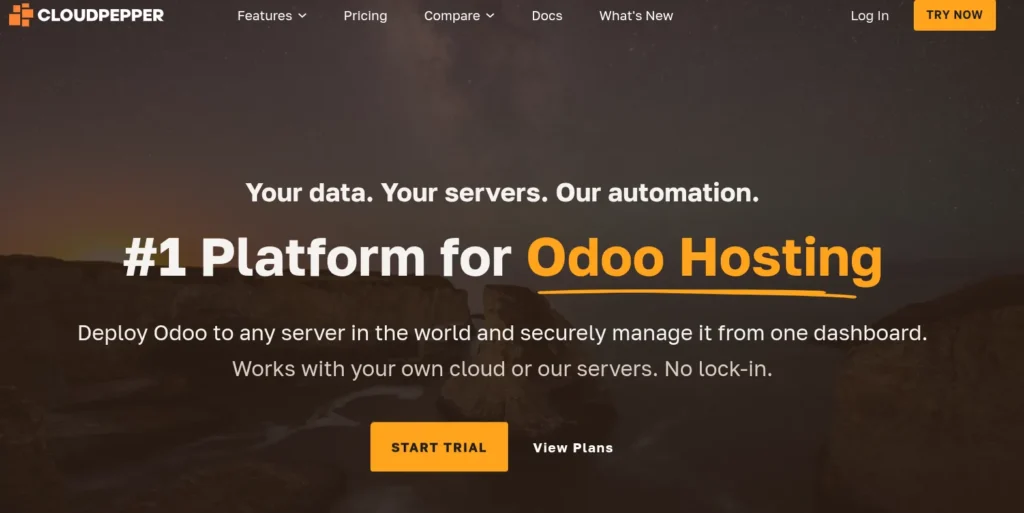
Cloudpepper specializes in Odoo hosting, trusted by 10,000+ Odoo projects across 130+ countries. Unlike generic web hosting providers adapting to support Odoo, Cloudpepper builds their entire platform specifically for Odoo deployments.
This platform was designed as a better alternative to official Odoo platforms (Odoo Online and Odoo.sh), addressing common pain points businesses face with Odoo infrastructure.
Two Deployment Approaches
Cloudpepper offers flexibility in how you approach infrastructure:
Managed Hosting: A complete turnkey solution where Cloudpepper provides the servers, handles all technical configuration, and manages everything. You simply use your Odoo system without touching any infrastructure.
DevOps Platform: You connect your existing AWS, DigitalOcean, Vultr, or even on-premise infrastructure to Cloudpepper’s management platform. They handle all Odoo-specific configuration and maintenance while you retain complete ownership of the underlying infrastructure.
Both approaches provide identical features: unlimited staging environments, Git integration with any repository, automated backups, and access to 900+ pre-vetted third-party Odoo addons. The DevOps model gives you infrastructure ownership and eliminates vendor lock-in entirely.
If you ever cancel Cloudpepper’s DevOps service, your servers and data remain intact with your cloud provider. No migration, no data exports, no transition headaches.
Performance That Matters for Business
Every Cloudpepper deployment receives dedicated server resources. You’re not sharing CPU, RAM, or storage with other customers. This eliminates the performance variability that plagues shared hosting environments.
For eCommerce and retail operations, performance consistency matters. Cloudpepper’s infrastructure delivers 67% faster response times compared to WooCommerce on equivalent server specifications. Retail chains running multiple POS locations benefit from dedicated server resources during peak traffic periods, with full server access for performance tuning when needed.
The platform includes unlimited staging environments as standard. You can test changes, try new modules, and validate configurations in isolated environments before pushing anything to production. This dramatically reduces the risk of changes affecting your live business operations.
Cloudpepper provides direct PostgreSQL access for custom optimization, supports both Community and Enterprise Odoo editions, and places no restrictions on custom modules or user counts. Your capacity is determined by your server resources, not artificial platform limitations.
Developer and Business Features
Cloudpepper’s platform supports deployment from any Git repository (GitHub, GitLab, Bitbucket, or your own custom Git server). This flexibility matters for development teams with existing workflows or security requirements around code repositories.
The platform provides access to 900+ third-party Odoo addons that have been tested and vetted. You also get full API access for custom integrations, advanced user management capabilities, and support for unlimited custom module installations.
Migration from any existing Odoo platform is straightforward. Cloudpepper handles migrations from Odoo.com, Odoo.sh, on-premise deployments, or any other hosting provider.
Moving Beyond Odoo.com and Odoo.sh
Teams often start with Odoo.com’s SaaS platform but need custom modules as they grow. Odoo.sh offers customization but ties pricing to Enterprise licenses, which can become expensive at scale.
Cloudpepper provides similar tooling (Git deployment, staging environments, automated backups) with flat-rate pricing. Migration guides help teams move from Odoo.com or Odoo.sh while preserving data and customizations.
Pricing Structure
Cloudpepper offers free trials: 3 days for server-included hosting, or 14 days when connecting your own infrastructure.
Managed Hosting (server included):
- Base: $41/month
- Pro: $61/month (unlimited servers)
- Agency: $262/month (white-label capabilities)
DevOps Platform (your infrastructure):
- Base: $29/month
- Pro: $49/month (unlimited servers)
- Agency: $250/month (white-label capabilities)
Pro and Agency plans include unlimited servers, instances, and staging environments for one flat monthly fee. No per-user charges, no surprise fees for additional environments.
Best For
Cloudpepper serves growing businesses needing reliable infrastructure without DevOps overhead. Teams outgrowing Odoo.com or seeking alternatives to Odoo.sh’s pricing model find the flat-rate approach appealing. E-commerce and retail operations with multiple POS locations benefit from dedicated resources. Multi-location businesses appreciate flexibility in choosing cloud providers for regional compliance.
Organizations wanting professional management without vendor dependency find Cloudpepper’s DevOps model particularly valuable. If you need Odoo to just work reliably while you focus on running your business, Cloudpepper delivers exactly that.
2. Microsoft Azure
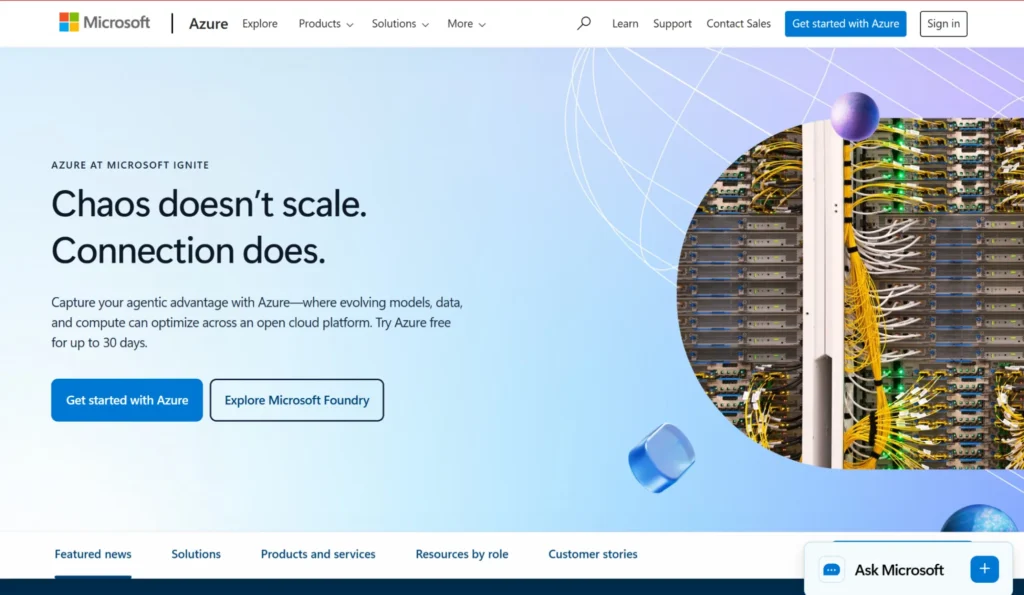
Microsoft Azure is an Infrastructure as a Service (IaaS) platform that provides cloud computing resources with deep integration into the Microsoft ecosystem. For businesses already operating in Microsoft’s world, Azure offers compelling advantages for Odoo hosting.
Enterprise Ecosystem Integration
About 95% of Fortune 500 companies use Microsoft Azure. If your business already operates in the Microsoft ecosystem with existing Azure contracts, hosting Odoo on the same platform optimizes costs, performance, and security.
Azure allows integration with Microsoft Entra ID for single sign-on (SSO). Users log into Odoo with their existing Windows or Office credentials. This integration extends to email and cloud storage, improving user experience and security through familiar authentication systems.
For enterprises, this seamless integration eliminates the friction of managing separate credential systems and improves security through centralized identity management.
Hybrid Cloud Capabilities
Services like Azure ExpressRoute and Azure Stack help connect on-premise systems to the Azure cloud for seamless integration. This matters for large organizations that can’t move all resources to the cloud at once.
The hybrid approach ensures seamless connectivity, allowing you to deploy Odoo in Azure while it communicates securely with your internal servers. With about 70% of the global ERP market moving to cloud ERP, Azure’s hybrid capabilities keep you positioned for gradual cloud migration.
Pricing and Complexity
Azure maintains compliance certifications including ISO 27001, SOC, HIPAA, and PCI DSS, which matters for regulated industries.
Azure uses a pay-as-you-go pricing model. Basic production setups start around $100-300/month, but enterprise deployments with high availability and auto-scaling typically run $1,000+/month. Costs can be unpredictable without careful monitoring.
Setup requires significant time investment and technical expertise in cloud architecture, Linux administration, PostgreSQL optimization, and Azure networking.
Pros
- Enterprise credibility for large clients and government entities
- Global reach for deploying Odoo instances anywhere
- Superior integration with Microsoft ecosystem
- Compliance certifications for regulated industries
Cons
- High cost and complexity
- Risk of vendor lock-in limiting migration options
- Support focused on Azure platform, not Odoo-specific issues
- You’re responsible for implementing and maintaining Odoo DevOps
Best For
Microsoft Azure makes sense for enterprises already invested in the Microsoft ecosystem, organizations with existing Azure contracts, companies with dedicated DevOps teams managing cloud infrastructure, and businesses requiring specific Microsoft integrations.
3. Google Cloud Platform (GCP)
Google Cloud Platform offers a suite of computing services with consistent cutting-edge performance, strong data analytics, and a rapid global network. GCP enables high-demand installations and opportunities to integrate advanced AI and machine learning features.
High-Performance Computing
GCP provides fast, scalable compute engines optimized for demanding workloads. Businesses with heavy reporting deployments, rapidly growing user bases, and data-intensive Odoo modules find GCP an ideal choice.
The platform’s software-defined networking delivers fast and reliable global connectivity. For organizations with distributed teams or customers, this global backbone network ensures consistent Odoo performance regardless of location.
AI and Machine Learning Integration
A major advantage of GCP is its suite of AI/ML tools, including BigQuery ML, Vertex AI, and advanced analytics capabilities. If you want to build intelligent features into your Odoo deployment (predictive analytics, automated reporting, smart recommendations), GCP provides the infrastructure and tools.
This matters for businesses looking to leverage their Odoo data for competitive advantage through advanced analytics and automation.
Competitive Pricing
GCP offers competitive pricing for long-running workloads with automatic sustained-use discounts. For continuous, stable Odoo deployments, costs become lower over time compared to other cloud providers.
New accounts receive $300 in credits to explore services, making it easy to test GCP for Odoo deployments before committing.
Basic production setups start around $50-100/month. Enterprise deployments with high availability run $500-1,000+/month depending on resource usage.
Pros
- Global backbone network delivers fast, scalable performance
- Strong AI and analytics ecosystem for advanced Odoo integrations
- High-performance infrastructure for large, resource-intensive projects
- Competitive long-term pricing with sustained-use discounts
Cons
- Limited Odoo-specific tools, requiring manual automation and deployment setup
- Requires technical expertise to configure security, scaling, and optimization
- Steeper learning curve than specialized Odoo hosting platforms
Best For
Google Cloud Platform works well for businesses with data-intensive operations, organizations wanting to integrate AI/ML capabilities with Odoo, companies with technical teams comfortable managing cloud infrastructure, and deployments requiring high-performance computing for demanding workloads.
Comparison Table
| Feature | Cloudpepper | Microsoft Azure | Google Cloud Platform |
|---|---|---|---|
| Starting Price | $41/mo | $100-300/mo | $50-100/mo |
| Setup Time | 5 minutes | Significant | Significant |
| Technical Skills Required | None | Very High | Very High |
| Management Level | Fully Managed | Self-Managed | Self-Managed |
| Odoo-Specific Features | Extensive | None | None |
| Scalability | Excellent | Excellent | Excellent |
| Best Performance For | Most deployments | Enterprise Microsoft shops | Data-intensive operations |
| Vendor Lock-In | Zero (DevOps model) | High | Medium |
How to Choose the Right Odoo Hosting
For Beginners/Standard Use:
If you’re new to Odoo or running standard operations without heavy customization, Cloudpepper offers the easiest path forward. The managed hosting handles all technical complexity, letting you focus on your business. Setup takes 5 minutes instead of days, and you get dedicated resources without sharing performance with other users.
Alternatives like Odoo Online or Odoo.sh work for basic needs, but limit customization and lock you into their ecosystem. Cloudpepper provides the same simplicity with more flexibility and better performance.
For Developers/Customization:
Development teams need Git integration, unlimited staging environments, and the ability to test thoroughly before deploying. Cloudpepper’s DevOps platform connects to any Git repository (GitHub, GitLab, Bitbucket) with automated CI/CD pipelines and zero-downtime deployments.
You get unlimited staging environments to test custom modules with real client data before going live. Unlike Odoo.sh which ties pricing to Enterprise licenses, Cloudpepper charges a flat fee regardless of how many environments you need.
For teams wanting complete infrastructure control, unmanaged VPS (Vultr, Linode) provides flexibility but requires significant DevOps expertise to manage servers, security, and Odoo optimization yourself.
For Large Scale/Full Control:
Enterprise deployments with complex requirements have several paths. Cloudpepper’s Pro and Agency plans provide unlimited servers and instances for a flat monthly fee, making it cost-effective to scale without surprise charges.
For organizations already invested in specific cloud ecosystems, Microsoft Azure delivers deep Microsoft integration. Google Cloud Platform excels for data-intensive operations needing AI/ML capabilities and high-performance computing.
The choice depends on your existing infrastructure. If you’re not already committed to Azure or GCP, Cloudpepper delivers enterprise-grade performance and scalability without the complexity and unpredictable costs of managing cloud infrastructure yourself.
Conclusion
For most businesses, Cloudpepper delivers the right balance: professional-grade hosting with dedicated resources, zero vendor lock-in through the DevOps platform, and predictable pricing. You get performance and reliability without becoming a systems administrator.
Microsoft Azure serves enterprises deeply embedded in the Microsoft ecosystem with specific integration needs. Google Cloud Platform excels for organizations with data-intensive operations wanting to leverage AI/ML capabilities.
Try Cloudpepper free for 3 days with their managed servers or 14 days with your own infrastructure. You’ll know within a few hours whether managed Odoo hosting is worth more than the DIY headaches of cloud infrastructure management.
