Odoo Statistics 2026: 66 Verified Facts and Figures
66 verified Odoo statistics for 2026: adoption, hosting, ERP market context, and technical performance. Every figure is traced to a primary source.
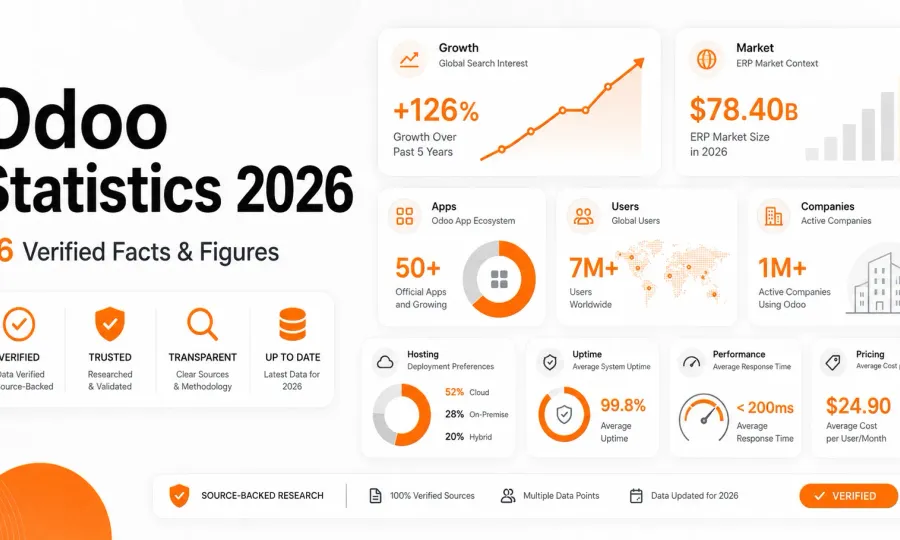
Odoo has grown from an open-source ERP project into one of the most widely adopted business software platforms globally. As of 2026, Odoo has a €7 billion valuation, fueled by its rapidly expanding app marketplace and global partner ecosystem.
This page brings together 66 Odoo statistics covering its adoption and growth, hosting and pricing, ecosystem and community, business and financial data, ERP market context, and technical performance. Every statistic is traced back to a primary source, which you can consult for further verification. If you’re a journalist, analyst, or business evaluating Odoo’s services, this serves as a single, source-backed reference.
It contains information on the following areas:
-
Odoo Hosting and Deployment Statistics
-
Odoo Adoption and Growth Statistics
-
Odoo Ecosystem and Community Statistics
-
Odoo Editions and Pricing Structure
-
Odoo Business and Financial Data
-
Odoo vs Competitors (ERP Market Context)
-
Odoo Performance and Technical Statistics
-
Sources for Every Odoo Statistic
Methodology
Every claim in this resource article was obtained from verifiable primary sources like Odoo’s press releases and documentation, investor announcements from Summit Partners, GitHub repositories, and Microsoft. Other primary information sources include Grand View Research, Apps Run The World, Panorama Consulting, and CNBC.
We have also included a summary table at the end of the article that lists every statistic and claim in one column, with the corresponding primary source link on the other. This ensures that you’ll be able to verify every claim made here on your own easily.
Key Odoo Statistics at a Glance
Here are 6 key Odoo statistics you should know about in 2026:
-
In recent years, Odoo has consistently maintained a sustained annual growth of approximately 40%
-
Between late 2024 and now, Odoo has recorded more than 7,000 new clients per month
-
As of September 2025, Odoo employs almost 7,000 individuals from around the world. The company is aiming to hit a 2026 target of 10,000
-
Both Odoo Online and Odoo.sh have a 99.9% uptime SLA rating, thanks to their Tier III-certified data centers
-
The top-10 ERP vendors in the world only control about 26.5% of the global ERP market, indicating that the competitive landscape is still highly fragmented.
-
Odoo’s Community Association (OCA) hosts 20,000 modules across more than 15 versions; meanwhile, the broader Odoo ecosystem actually offers more than 40,000 community apps.
Odoo Hosting and Deployment Statistics
Your hosting choice determines the kind of customization flexibility, scalability, and total cost of ownership you’ll get with ERP platforms. The following Odoo statistics detail the company’s hosting specifics and demonstrate how they compare with other ERP choices on the market.
Key Odoo hosting and deployment statistics:
-
Odoo Enterprise comes with hosting support options on three official platforms: Odoo online (SaaS), Odoo.sh (PaaS), and Odoo On-Premises (odoo.com, 2026)
-
Independent managed hosting platforms now run Odoo at scale outside Odoo’s own infrastructure. Cloudpepper, for example, manages over 10,000 Odoo instances for 300+ partners and 2,000+ businesses across 130+ countries (Source: cloudpepper.io, 2026)
-
Odoo Online and Odoo.sh both have a 99.9% uptime SLA rating (odoo.com, 2026). Note that this figure excludes planned maintenance exercises.
-
Odoo has a One App Free plan that costs $0 for unlimited users. This means that your company gets to use one Odo app without paying anything, and any number of employees can use it. The only caveat is that it is restricted to a single application (odoo.com, 2026)
-
All paid Odoo plans include 24/7 monitoring as an added feature (odoo.com, 2026)
-
When subscribing to Odoo.sh, users can select between 1 and 8 workers on shared hosting, 1 and 512 GB for storage, and different staging environment alternatives. Users also get to choose whether to opt for shared or dedicated servers (odoo.com, 2026)
-
Beyond Odoo’s three official hosting options, third-party platforms like Cloudpepper let businesses deploy Odoo on any major cloud, including AWS, Google Cloud, Azure, DigitalOcean, Hetzner, and Vultr, while keeping ownership of the underlying servers (Source: cloudpepper.io, 2026)
-
The global cloud ERP market has a compound annual growth rate (CAGR) of 18.0%, and analysts project its valuation will hit $110.26 billion by 2030 (Source: Grand View Research, 2025)
-
On a comparable mid-sized setup (5 workers, 100 GB storage, 2 staging environments), third-party managed Odoo hosting can run around $73/month, vs roughly $164/month for the equivalent Odoo.sh configuration (Source: cloudpepper.io, 2026)
-
Managed Odoo hosting providers increasingly run on enterprise security baselines, with platforms like Cloudpepper operating on ISO 27001 and SOC 2 certified infrastructure behind a 99.9% uptime guarantee (Source: cloudpepper.io, 2026)
Odoo Adoption and Growth Statistics
Since its introduction into the ERP market, Odoo has experienced significant adoption across global markets, thanks to its open-source and modular design. The following statistics help to quantify Odoo’s adoption and growth success.
Key Odoo adoption and growth statistics:
-
In recent years, Odoo has consistently experienced a 40% sustained annual growth rating (Source: odoo.com, 2024)
-
Approximately 7,000 new clients per month choose Odoo as their ERP solution, and this trend has been on since late 2024 (Source: odoo.com, 2024)
-
Odoo’s partner program is divided into three tiers: Ready, Silver, and Gold. The Gold partners represent the highest level of certification and expertise (Source: odoo.com, 2026)
Odoo Ecosystem and Community Statistics
One key reason why Odoo has experienced significant growth in recent years is its large open-source ecosystem that features several community-built modules and contributors. There is also an annual conference that consistently draws in tens of thousands of attendees. The following Odoo statistics will help shed more light on the scale of its massive ecosystem.
Key Odoo ecosystem and community statistics:
-
The Odoo Community Association (OCA) hosts more than 20,000 open-source modules across over 15 versions of the Odoo software (Source: odoo-community.org, 2026)
-
There are over 1,117 active contributors in the Odoo Community Association, which significantly increases Odoo’s community development longevity (Source: odoo-community.org, 2026)
-
There are now 49 country-specific Odoo localizations, thanks to OCA contributions (Source: odoo.com, 2025)
-
In the Odoo 19 Functional Certification exam, candidates have 1.5 hours to answer 120 questions across 18 subject areas. They must achieve a minimum score of 70% to get a passing grade (Source: odoo.com, 2026)
-
There were more than 40,000 attendees from over 150 countries in the Odoo Experience 2025 conference, which was held from September 18 to 20 at Brussels Expo (Source: odoo.com, 2025)
-
The Odoo Experience 2025 featured over 400 exhibitors and 400 talks, along with 7 master classes and 4 live concerts (Source: odoo.com, 2025)
Odoo Editions and Pricing Structure
This section contains Odoo statistics and facts about the editions of the ERP software currently available on the market and their pricing scale.
Key Odoo editions and pricing structure statistics:
-
Odoo currently has two editions: Odoo Community and Odoo Enterprise. Odoo Community is the core open-source tool that is distributed under the LGPL license. Enterprise, on the other hand, is Odoo’s commercial layer that comes fitted with licensed modules and official support (Source: odoo.com, 2026)
-
Ododo officially recommends Success Packs and direct onboarding support for companies with fewer than 50 employees (Source: odoo.com, 2026)
-
Companies that have over 50 employees are typically directed to Odoo’s partner network for implementation support (Source: odoo.com, 2026)
-
Large enterprises with 250+ employees are advised to work directly with Odoo for implementation (Source: odoo.com, 2026)
-
Popular industrial organizations like Toyota Material Handling France and Airbus use Odoo for ERP needs (Source: odoo.com, 2026)
Odoo Business and Financial Data
A close look at Odoo’s business and financial data shows that the company shows a rare combination of sustained profitability, global expansion, and disciplined fundraising. Here are some key statistics that reflect a true picture of Odoo’s financial performance, funding history, and organizational scale.
Key Odoo business and financial statistics:
-
Odoo S. A. was founded in April 2002 by Fabien Pinckaers. He is still the company’s CEO (Source: odoo.com, 2024)
-
Odoo has its headquarters in Louvain-la-Neuve, Belgium (Source: odoo.com, 2024)
-
Odoo first launched in 2005 under the name TinyERP. This company later rebranded to OpenERP, before settling on Odoo in 2014 (Source: odoo.com)
-
Odoo initially raised only €10 million across two funding rounds between 2010 and 2014. This includes a Sofinnova Partners seed round and a Series B led by XAnge and SRIW. (Source: Summit Partners, 2021)
-
Summit Partners made their first investment in Odoo in December 2019 (Source: Summit Partners, 2024)
-
In July 2021, Odoo had another successful raise where it successfully raised €180 million in a funding round led by Summit Partners. At this time, Odoo was already profitable, recording figures like 7 million users, 1,700 employees, and €160 million in projected annual billings (Source: Summit Partners, 2021)
-
By 2023, Odoo had more than doubled in size, with official reports showing that the company now had €370 million in annual billings (Source: CNBC, 2024)
-
In November 2024, Odoo completed a €500 million secondary transaction led by CapitalG and Sequoia Capital. Other notable VCs that participated in this raise event include BlackRock, Mubadala, HarbourVest Partners, AVP, and Alkeon(Source: odoo.com, 2024)
-
It is predicted that Odoo’s billings will reach €650 million following the 2024 transaction, with a target of €1 billion by 2027 (Source: odoo.com, 2024)
-
Statistics show that Odoo employed nearly 7,000 people globally as of September 2025. The company has plans to increase its workforce to 10,000 employees in 2026 (Source: odoo.com, 2025)
-
According to a 2021 report, there are over 90,000 Odoo-related jobs across 150 countries thanks to Odoo’s partner ecosystem (Source: Summit Partners, 2021)
Odoo vs Competitors (ERP Market Context)
In this section, you will find Odoo statistics that detail how the company compares with the broader ERP market in key areas like vendor rankings, pricing benchmarks, and implementation outcomes.
Key Odoo vs competitors statistics:
-
The largest ERP industry vertical by revenue is manufacturing. It is followed by financial services, retail, healthcare, and government sectors (Source: Apps Run The World, 2025)
-
Oracle became the largest ERP vendor by revenue in 2024, surpassing SAP for the first time (Source: Apps Run The World, 2025)
-
Oracle generated $8.77 billion in ERP revenue in 2024. This figure represented about 6.63% of the total market share (Source: Apps Run The World, 2025)
-
SAP generated $8.69 billion in ERP revenue in 2024. This represented around 6.57% of the total market share (Source: Apps Run The World, 2025)
-
The top 10 ERP vendors globally are Oracle, SAP, Intuit, Constellation Software, Microsoft, FIS Global, IQVIA, Roper Technologies, Sage, and Infor (Source: Apps Run The World, 2025)
-
The top 10 ERP vendors collectively control only 26.5% of the total ERP market (Source: Apps Run The World, 2025)
-
There are generally three tiers of ERP systems based on target company size (Source: Panorama Consulting, 2024)
-
Tier I ERP systems serve organizations with $250 million to $750 million or more in revenue. Examples include SAP’s S/4HANA and Oracle’s Fusion Cloud ERP (Source: Panorama Consulting, 2024)
-
Tier II ERP systems serve organizations with $10 million to $250 million in revenue. Examples include Microsoft Dynamics 365 Finance and Sage X3 (Source: Panorama Consulting, 2024)
-
As of November 1, 2025, a subscription to Microsoft Dynamics Business Central costs $80 per user/month (Essentials) and $110 per user/month (Premium) (Source: Microsoft, 2025)
-
The average cost of ERP implementation for a business is $450,000. This includes services like licensing, data migration, training, and customization (Source: Panorama Consulting, 2025)
-
More than 25% of ERP implementations exceed their budget. According to studies, the primary reasons for this include late-stage scope changes and additional technology needs (Source: Panorama Consulting, 2025)
-
Over 50% of organizations stayed within budget in 2025 (Source: Panorama Consulting, 2025)
Odoo Performance and Technical Statistics
Odoo’s performance and technical statistics are shaped by its worker-based architecture and cloud infrastructure design. They include the following. For a hands-on tuning reference, see the Odoo and PostgreSQL performance guide.
Key Odoo performance and technical statistics:
-
To set up an Odoo server, here’s the recommended formula for workers = (CPU cores × 2) + 1. This means that a 4-core server would be able to run 9 workers. This includes 8 HTTP workers and 1 cron worker (Source: odoo.com, 2026)
-
Odoo uses a RAM estimation formula to allocate memory based on worker type distribution. For example, a 9-worker setup will require approximately 3GB of RAM for the application layer. This assumes that the worker-type distribution is 80% light workers (~150MB each) and 20% heavy workers (~1GB each), excluding PostgreSQL memory (Source: odoo.com, 2026)
-
If you’re using Odoo on default settings, the default configuration includes limits such as 8,192 requests per worker before restart. The maximum execution times you’ll get are 600 seconds (CPU) and 1,200 seconds (real time), with one cron thread by default (Source: odoo.com, 2026)
-
Odoo cloud services have a 99.9% uptime SLA rating. The maximum limit of unplanned downtime per month is 45 minutes (Source: odoo.com, 2026)
-
According to Odoo’s official schedule, planned maintenance occurs once every few months and lasts less than one hour. These planned maintenance are usually scheduled outside customer business hours (Source: odoo.com, 2026)
-
Odoo’s cloud infrastructure uses Tier III-certified data centers or equivalent with N+1 redundancy (Source: odoo.com, 2026)
-
For Odoo customers within the same geographic region, databases are replicated in near real-time (Source: odoo.com, 2026)
-
To ensure optimal data security, Odoo frequently carries out data backups daily, weekly, and monthly. This involves conducting 14 rolling backups per database over a minimum of 3 months (Source: odoo.com, 2026)
-
Odoo copies and stores user data, which backs up across at least three machines in different data centers. In addition, there is also an immutable cold storage copy. This helps to ensure that you can download manual backups whenever you want (Source: odoo.com, 2026)
-
In cases of single-server failures, Odoo has a Recovery Time Objective (RTO) of 6 hours. This means that services should be restored within 6 hours. Odoo’s Recovery Point Objective (RPO) is up to 24 hours (Source: odoo.com, 2026)
-
For full data center failures, Odoo targets both RTO and RPO of 24 hours (Source: odoo.com, 2026)
-
A single Odoo worker can handle approximately 6 concurrent users on average (Source: odoo.com, 2026)
Why These Odoo Statistics Matter
Odoo has successfully evolved from a small open-source project into an ERP company that is now valued at €7 billion. These statistics are a veritable repository of Odoo’s growth milestones in various areas like ecosystem scale, market positioning, and overall adoption.
If you’re a business currently evaluating whether Odoo is the right fit for you, here are key takeaways you should know:
-
Built-in flexible hosting: Odoo offers both SaaS and PaaS hosting options. You can even set up self-hosted deployments with Odoo, so you can choose whichever best suits your business needs, compliance requirements, and budget.
-
Fast and consistent growth: Odoo is currently pulling in 7,000 new clients per month, and the company has achieved a sustained annual growth rate of 40% in recent years. This is a better adoption curve than the broader ERP market average, meaning Odoo is enjoying elevated growth levels.
-
The ecosystem is mature: Right now, there are over 20,000 OCA modules, 1,100 contributors, and 40,000 community apps in the Odoo ecosystem. This means that it’s very easy for businesses to customize the ERP platform without needing a huge, enterprise-grade customization budget.
-
Pricing scales with company size: Odoo offers a simple tiered pricing system that makes it easy for companies to start at low costs and scale easily as operations grow.
-
Financial strength reduces vendor risk: Odoo has already achieved consistent profitability, a successful fundraising history, and it has a €7 billion valuation. This indicates that Odoo is a stable, long-term ERP platform that businesses can trust.
-
ERP market fragmentation: Statistics show that the top 10 ERP vendors only control 26.5% of the market. This means that as a business, you now have more freedom to choose flexible, more affordable, open-source, and modular platforms like Odoo without worrying about premium pricing or quality compromise. For a deeper look at how Odoo stacks up, see our Odoo vs. Microsoft Dynamics 365 and Odoo vs. QuickBooks comparisons.
-
Lower Total Cost of Ownership: Running ERP implementation with Tier I/II systems will cost you an average of $450,000. With Odoo, on the other hand, you get a modular pricing model that significantly lowers your overall total cost of ownership.
-
Reliable enterprise-level performance: Statistics show that Odoo currently offers 99.9% uptime SLAs, Tier III data centers, 14 rolling backups, and defined RTO/RPO targets. This means that with Odoo Online and Odoo.sh, you’re getting enterprise-grade technical reliability without the associated premium costs.
As businesses grow and their systems become more complex, infrastructure becomes more important. Companies like Cloudpepper provide managed hosting services to help businesses manage and host Odoo environments globally without needing to handle the infrastructure directly.
Sources for Every Odoo Statistic
Every figure in this article is backed by a primary source. The table below maps each claim to the page it came from. Use the search function (Ctrl+F / Cmd+F) with the snippet text to find any stat within the article body above.
| Claim | Source |
|---|---|
| 40% sustained annual growth | https://www.odoo.com/blog/odoo-news-5/odoo-sa-announces-a-500-million-transaction-increasing-the-belgian-unicorns-valuation-to-5-billion-1508 |
| 7,000 new clients per month | https://www.odoo.com/blog/odoo-news-5/odoo-sa-announces-a-500-million-transaction-increasing-the-belgian-unicorns-valuation-to-5-billion-1508 |
| three tiers: Ready, Silver, and Gold | https://www.odoo.com/partners |
| three official platforms | https://www.odoo.com/pricing |
| 99.9% uptime SLA | https://www.odoo.com/cloud-sla |
| $0 for unlimited users | https://www.odoo.com/pricing |
| 24/7 monitoring | https://www.odoo.com/cloud-sla |
| 1 and 8 workers | https://www.odoo.sh/faq |
| $110.26 billion by 2030 | https://www.grandviewresearch.com/press-release/global-cloud-enterprise-resource-planning-erp-market |
| 49 country-specific localizations | https://odoo-community.org/ |
| 120 questions across 18 subject areas | https://www.odoo.com/slides/odoo-19-functional-certification-502 |
| more than 40,000 attendees from over 150 countries | https://www.odoo.com/event/odoo-experience-2025-6601/page/oxp25-introduction |
| over 400 exhibitors and 400 talks | https://www.odoo.com/event/odoo-experience-2025-6601/page/oxp25-introduction |
| two editions: Odoo Community and Odoo Enterprise | https://www.odoo.com/page/editions |
| Success Packs and direct onboarding support for companies with fewer than 50 employees | https://www.odoo.com/pricing |
| Over 50 employees are typically directed to Odoo’s partner network | https://www.odoo.com/pricing |
| 250+ employees are advised to work directly with Odoo | https://www.odoo.com/pricing |
| Toyota Material Handling France and Airbus | https://www.odoo.com/blog/customer-reviews-6 |
| April 2002 by Fabien Pinckaers | https://www.odoo.com/blog/odoo-news-5/odoo-sa-announces-a-500-million-transaction-increasing-the-belgian-unicorns-valuation-to-5-billion-1508 |
| Louvain-la-Neuve, Belgium | https://www.odoo.com/blog/odoo-news-5/odoo-sa-announces-a-500-million-transaction-increasing-the-belgian-unicorns-valuation-to-5-billion-1508 |
| 2005 under the name TinyERP | https://www.odoo.com/page/fabien-pinckaers-biography |
| only €10 million across two funding rounds between 2010 and 2014 | https://www.summitpartners.com/news/odoo-the-open-source-erp-leader-announces-eu180m-new-investment-from-summit-partners |
| First investment in Odoo in December 2019 | https://www.summitpartners.com/news/odoo-announces-a-500-million-transaction-increasing-the-belgian-unicorns-valuation-to-5-billion |
| €180 million in a funding round led by Summit Partners | https://www.summitpartners.com/news/odoo-the-open-source-erp-leader-announces-eu180m-new-investment-from-summit-partners |
| €370 million in annual billings | https://www.cnbc.com/2024/11/20/software-firm-odoo-hits-5point3-billion-valuation-in-secondary-share-sale.html |
| €500 million secondary transaction led by CapitalG and Sequoia Capital | https://www.odoo.com/blog/odoo-news-5/odoo-sa-announces-a-500-million-transaction-increasing-the-belgian-unicorns-valuation-to-5-billion-1508 |
| €7 billion | https://www.generalatlantic.com/media-article/general-atlantic-announces-close-of-further-investment-into-odoo-acquiring-additional-stake-from-wallonie-entreprendre/ |
| Odoo’s largest institutional shareholder | https://www.summitpartners.com/news/odoo-announces-a-500-million-transaction-increasing-the-belgian-unicorns-valuation-to-5-billion |
| both EBITDA and cash flow | https://www.cnbc.com/2024/11/20/software-firm-odoo-hits-5point3-billion-valuation-in-secondary-share-sale.html |
| €650 million following the 2024 transaction, with a target of €1 billion by 2027 | https://www.odoo.com/blog/odoo-news-5/odoo-sa-announces-a-500-million-transaction-increasing-the-belgian-unicorns-valuation-to-5-billion-1508 |
| nearly 7,000 people globally as of September 2025 | https://www.odoo.com/blog/odoo-news-5/odoo-unveils-its-results-and-ambitious-projects-at-odoo-experience-2025-1857 |
| 90,000 Odoo-related jobs across 150 countries | https://www.summitpartners.com/news/odoo-the-open-source-erp-leader-announces-eu180m-new-investment-from-summit-partners |
| largest ERP industry vertical by revenue | https://www.appsruntheworld.com/top-10-erp-software-vendors-and-market-forecast/ |
| largest ERP vendor by revenue in 2024 | https://www.appsruntheworld.com/oracle-surpasses-sap-to-become-no-1-erp-apps-provider/ |
| $8.77 billion in ERP revenue in 2024 | https://www.appsruntheworld.com/top-10-erp-software-vendors-and-market-forecast/ |
| $8.69 billion in ERP revenue in 2024 | https://www.appsruntheworld.com/top-10-erp-software-vendors-and-market-forecast/ |
| top 10 ERP vendors | https://www.appsruntheworld.com/top-10-erp-software-vendors-and-market-forecast/ |
| only 26.5% of the total ERP market | https://www.appsruntheworld.com/top-10-erp-software-vendors-and-market-forecast/ |
| three tiers | https://www.panorama-consulting.com/resource-center/erp-report/ |
| serve organizations with $250 million to $750 million | https://www.panorama-consulting.com/resource-center/erp-report/ |
| serve organizations with $10 million to $250 million | https://www.panorama-consulting.com/resource-center/erp-report/ |
| $80 per user/month (Essentials) and $110 per user/month (Premium) | https://www.microsoft.com/en-us/dynamics-365/blog/business-leader/2025/05/06/new-microsoft-dynamics-365-business-central-pricing-effective-november-2025/ |
| $450,000 | https://www.panorama-consulting.com/resource-center/erp-report/ |
| 25% of ERP implementations exceed their budget | https://www.panorama-consulting.com/panorama-consulting-group-releases-latest-study-of-erp-implementation-outcomes-across-the-globe/ |
| 50% of organizations stayed within budget in 2025 | https://www.panorama-consulting.com/resource-center/erp-report/ |
| workers = (CPU cores × 2) + 1 | https://www.odoo.com/documentation/19.0/administration/on_premise/deploy.html |
| based on worker type distribution | https://www.odoo.com/documentation/19.0/administration/on_premise/deploy.html |
| limits such as 8,192 requests per worker | https://www.odoo.com/documentation/19.0/administration/on_premise/deploy.html |
| approximately 45 minutes of unplanned downtime | https://www.odoo.com/cloud-sla |
| Once every few months and lasts less than one hour | https://www.odoo.com/cloud-sla |
| Tier III-certified data centers or equivalent with N+1 redundancy | https://www.odoo.com/cloud-sla |
| in near real-time within the same geographic region | https://www.odoo.com/cloud-sla |
| 14 rolling backups per database over a minimum of 3 months | https://www.odoo.com/cloud-sla |
| at least three machines in different data centers | https://www.odoo.com/cloud-sla |
| Recovery Time Objective (RTO) of 6 hours | https://www.odoo.com/cloud-sla |
| Both RTO and RPO of 24 hours | https://www.odoo.com/cloud-sla |
| approximately 6 concurrent users on average | https://www.odoo.com/documentation/19.0/administration/on_premise/deploy.html |
| 40,000 community apps | https://www.odoo.com/blog/business-hacks-1/thai-smes-a-guide-to-business-elevation-2233 |